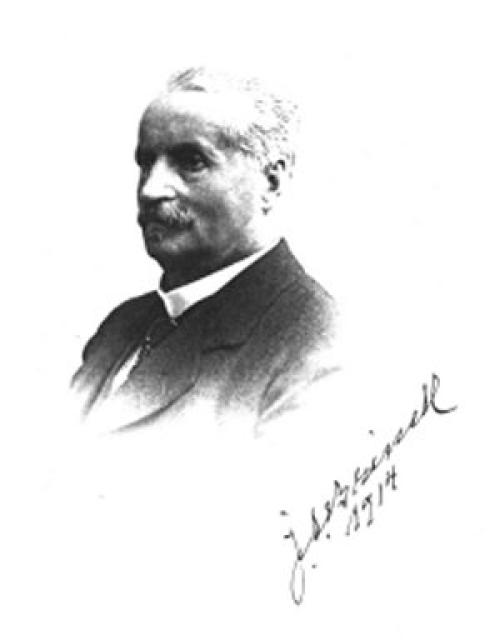
Johan August Brinell
 Sweden
Biography of Johan August Brinell
Johan August Brinell was a Swedish engineer and metallurgist known for his contributions to the field of steel metallurgy and the determination of metal hardness. He was born in the village of Bringetofta, south of the city of Nässjö, in the Jönköping County. Brinell's parents were farmers.
After completing five years of education at a gymnasium in Jönköping, Brinell continued his studies at the technical school in Borås, graduating in 1871. Following his work as a draftsman at various companies, Brinell became an engineer at a metallurgical plant in Lesjöfors, Värmland, in 1875. In 1882, he became the chief engineer at a plant in Fagersta, Västmanland.
From 1903 to 1914, Brinell served as the chief engineer of the Swedish Association of Metallurgical Industries (Jernkontoret) and was the editor of the journal "Jernkontorets Annaler." In 1880, Brinell married Selma Josefine Elisabet Nilsson, and they had five children. He was elected a member of the Royal Swedish Academy of Sciences in 1902 and the Royal Swedish Academy of Engineering Sciences in 1919.
In his later years, he lived in Nässjö. Today, Brinell is most famous for his development of the static method for determining hardness, which is widely used in the industry. The Brinell hardness test, proposed in 1900, involves indenting a material with a hard metal ball (usually 10mm in diameter) under a specific load (typically 30 kN). The ratio of the applied load to the surface area of the indentation gives the Brinell hardness number (HB).
However, Brinell's most significant contributions lie in his innovative work on phase transformations in steel. While working in Fagersta, Brinell conducted extensive research on the structure of steel during heating and cooling. His work, "On Changes in the Structure of Steel During Heating and Cooling," published in the Jernkontorets Annaler in 1885, attracted significant attention.
His research on the properties of steel was presented at the Stockholm Exhibition in 1897 and the World Exhibition in Paris in 1900. Despite using primitive equipment and relying on his eyes and experience, Brinell continued his research for many years and achieved results that "greatly influenced the global industry." His discoveries regarding carbon-containing phases still form the basis of modern knowledge on the properties of steel.
Few metallurgists have done as much for the progress of metallurgy as Brinell, earning him international recognition as a highly competent researcher and successful manager in the metallurgical industry.
Brinell received numerous awards and honors throughout his career, including the Grand Prix at the Paris World Exhibition in 1900, the Polhem Medal from the Swedish Association of Engineering Students in 1900, the Bessemer Gold Medal from the Institute of Iron and Steel in London in 1907, and an honorary doctorate from Uppsala University in 1907. He also received the Gold Medal of Rinman from the Swedish Association of Metallurgical Industries in 1921.
Several streets and educational institutions in Sweden are named after Brinell in his honor.


