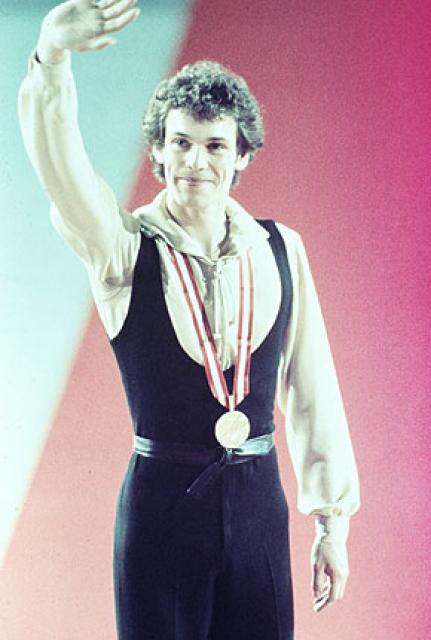
John Anthony Curry
 Great Britain
Biography of John Curry
Early Life and Career
John Curry was born in Birmingham, England. He received his education at Solihull School. As a child, Curry dreamt of becoming a dancer, but his father did not approve of dance as a suitable activity for a boy. Instead, at the age of 7, Curry began taking figure skating lessons. Initially, the sport was not a serious pursuit for him.
Training and Success
When Curry turned 16, his father passed away, and the figure skater moved to London to train under Arnold Gershwiler. Curry once again began taking the forbidden dance lessons and dedicated most of his time to figure skating. With Gershwiler's guidance, Curry won his first British championship title in 1971. In 1972, Curry found an American sponsor, allowing him to move to the United States and start working with coaches Gustave Lussi and Carlo Fassi. Under Fassi's guidance, the skater achieved victory at the European and World Championships in 1976, as well as becoming an Olympic champion. At the 1976 Olympic Games, he also carried the flag for the British team.
Skating Style and Achievements
Curry's skating style was characterized by balletic positions, incorporation of dance elements, and exceptional body control. Alongside Canadian figure skater Toller Cranston, Curry emphasized the aesthetic side of men's skating and elevated the expressiveness of the sport to a new level. He excelled in compulsory figures and jumps. After the 1976 World Championships, Curry turned professional and established his own ice show and a studio for traditional dances. In addition to his own choreographed programs, Curry collaborated with renowned dance choreographers Peter Martins and Twyla Tharp.
Later Years and Legacy
In his personal interactions, Curry was known to be difficult, leading to conflicts with management that led him to suspend his activities in the mid-1980s. Afterward, Curry rarely appeared in public. In 1987, he was diagnosed with HIV, followed by AIDS in 1991. He passed away from a heart attack in 1994 at the age of 44. Despite his short life, Curry's impact on figure skating remains significant, as he revolutionized the sport and brought a new level of beauty and artistry to men's skating.


