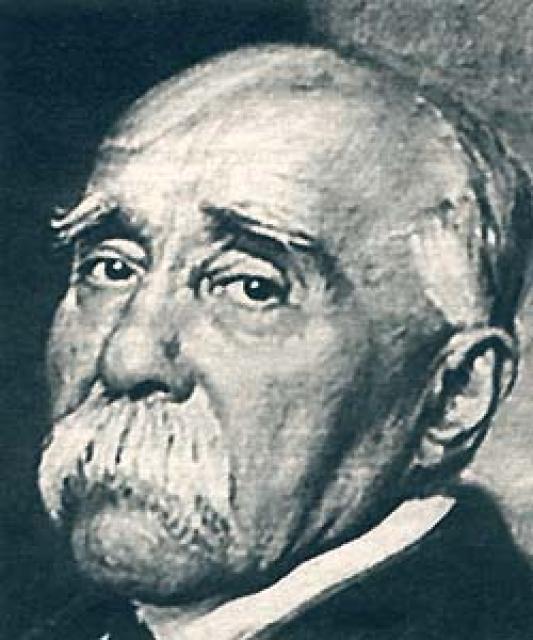
Jordge Clemenceau
 France
- Georges Clemenceau - The Tiger and Father of Victory
- A Passionate Republican and Political Activist
- A Lifelong Pursuit of Realizing France's Interests
- The Voice Against Corruption and Champion of Justice
- A Legacy of Selflessness and Financial Struggles
Georges Clemenceau - The Tiger and Father of Victory
Georges Clemenceau was a prominent political and statesman figure of the Third Republic in France. Born in Vendée in 1841, he began his career as a fervent leftist and underwent a transformative journey to become a stalwart republican throughout his life. Clemenceau dedicated his political career to serving his country, embodying selfless love for his homeland and a relentless pursuit of its real interests. His approach to politics and war was characterized by courage, cold calculation, and a strict sense of honesty and fairness towards the people he served.
A Passionate Republican and Political Activist
Clemenceau's early years were spent in a France torn apart by political divisions. His father, Benjamin Clemenceau, was a staunch republican, while his uncle, Paul Clemenceau, was a Bonapartist. This familial disagreement over political ideology was Clemenceau's first lesson in the harsh reality of political conflicts.
During the establishment of the Second Empire under Napoleon III in 1851, democratic institutions were dismantled, and France experienced a repressive regime. It was during this time that Clemenceau developed his passion for politics and social justice. He actively participated in political activities and demonstrations, which eventually led to his imprisonment for propaganda and organizing anti-government protests.
A Lifelong Pursuit of Realizing France's Interests
Although Clemenceau pursued a medical degree at the Sorbonne, his true passion lay in politics. He immersed himself in the vibrant political scene of Paris, associating with notable figures of the French revolutionary movement. However, his interest in medicine waned, and his doctoral dissertation was passed merely because it went unread. Clemenceau abandoned the medical field to focus entirely on his political aspirations.
Returning to Paris in 1870, Clemenceau found himself in the midst of the Franco-Prussian War. He was appointed the mayor of the Montmartre district, primarily inhabited by workers. He witnessed the siege of Paris, the flight of the government to Versailles, and the tumultuous events of the Paris Commune, during which he narrowly escaped execution by the communards.
The Voice Against Corruption and Champion of Justice
Clemenceau was known for his uncompromising stance against corruption within the government and parliament. He fought tirelessly against any form of bigotry and championed the cause of Alfred Dreyfus, an unjustly accused Jewish officer. Clemenceau believed firmly in the need to eradicate social injustices and the dangers of spreading hateful sentiments, especially within the military.
At the age of 76, Clemenceau became the Prime Minister of France in 1917, a critical period as Russia had withdrawn from the war. He led France through the final stages of World War I, playing a vital role in the Versailles Peace Conference. His tough stance against Germany aimed to prevent any possibility of a German revanchist movement in the future.
A Legacy of Selflessness and Financial Struggles
Georges Clemenceau passed away in 1929 at his father's home in Obre. Despite his remarkable contributions to the nation, he died deeply in debt. The parliament allocated funds for his funeral, honoring his merits and his position. Throughout his lifetime, Clemenceau served as a deputy for half a century, held ministerial positions, and served as both Prime Minister and Minister of War. Remarkably, he never took a single penny for his services, embodying true selflessness and dedication to his country.


