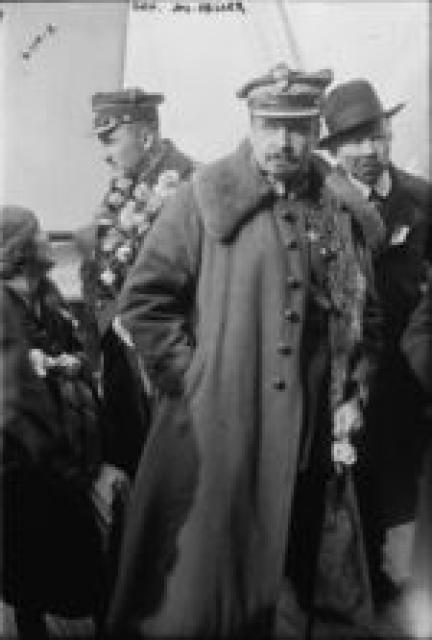
Josef Haller
 Poland
- Early Life and Military Career
- Resignation and Social Activism
- Return to Military Service
- Defection to France and Creation of the Haller Army
- Arrival of the Haller Army in Poland
- Later Career and Post-War Activities
- Retirement, Political Involvement, and Exile
Early Life and Military Career
Józef Haller was an Austrian officer who later became a Polish general. He received his military education at the Vienna Military Technical Academy and was commissioned as an officer in 1895. He served in the Austrian army's 11th Artillery Regiment.
Resignation and Social Activism
In 1910, Haller retired from the military with the rank of captain. He became involved in public affairs, participating in the rural cooperative movement and promoting scouting and Sokol (nationalist gymnastic) activities among Polish youth.
Return to Military Service
With the outbreak of World War I, Haller rejoined the Austrian army. He served in the Polish Legion, a unit of the Austrian army composed of Polish soldiers. He rose through the ranks, commanding a battalion and a regiment. In 1915, he was promoted to colonel and took part in the fighting in the Carpathians. From 1916, he led the 2nd Brigade of the Polish Legion.
Defection to France and Creation of the Haller Army
Following the Brest-Litovsk Treaty in 1918, Haller escaped to Moscow amid the chaos in Ukraine, where Polish units were stationed. From there, he traveled to France via Murmansk, arriving in July 1918.
In 1917, before Haller's arrival, the first units of the Polish army had been created in France as part of an alliance between French President Raymond Poincaré and Polish statesman I. Paderewski. The army recruited from Polish soldiers serving in the French army, former Polish prisoners of war from Germany, and former soldiers of the Austro-Hungarian Empire (totaling around 35,000). An additional 23,000 soldiers came from the United States. Others joined from across the world, including former members of the Russian Expeditionary Force in France and Polish immigrants from Brazil. Initially, the army was under French political control and commanded by General Louis Archinard. On February 23, 1918, political control was transferred to the Polish National Committee.
Arrival of the Haller Army in Poland
By April-June 1919, the Haller Army had grown to 70,000 soldiers and was transferred to Poland with all its equipment. It played a crucial role in the Polish-Ukrainian War in Eastern Galicia, defending Lviv from Ukrainian forces. In May 1919, Haller's army was deployed to the Polish-Russian front, engaging in numerous battles against the Red Army, particularly against S. Budyonny's cavalry. In June 1919, Haller commanded the Southwestern Front on the border with Germany. In September 1919, the Haller Army was reorganized and became part of the Polish army.
Later Career and Post-War Activities
During the Soviet-Polish War, Haller commanded the Polish Northern Front from July 23, 1920. In January 1920, he led the Polish conquest of Pomerania. In July 1920, Haller became Inspector General of the Volunteer Army, a member of the National Defense Council, and chairman of the Civil Commission for National Defense and the Red Cross. From 1920-1926, he served as Inspector of Artillery. He was a member of the Polish Sejm from 1922-1927, representing the Christian Union of National Unity coalition.
Retirement, Political Involvement, and Exile
Haller condemned the May 1926 coup d'état led by Józef Piłsudski and was subsequently dismissed from the army. He remained politically active, leading the Labor Party. After Poland's defeat and occupation by Nazi Germany in World War II, Haller served in the Polish government-in-exile led by Władysław Sikorski from 1940-1943, where he held the position of Minister of Education. He settled in England after the war.