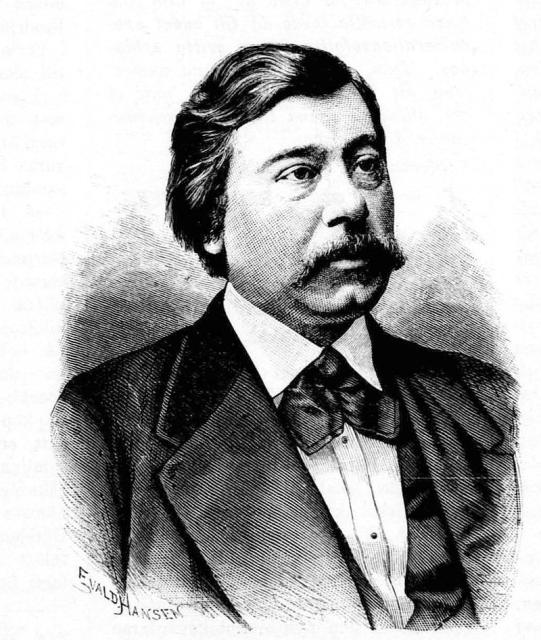
Joseph Dente
 Sweden
- Early Life and Training
- Orchestra, Opera, and a First Success
- Teacher and Composer
- Later Years and Legacy
Joseph Dente’s career began astonishingly early: at fifteen, he was already playing violin in Stockholm’s Royal Court Orchestra. Over the next half-century he would move between the orchestra pit, the conductor’s podium, the conservatory classroom, and the composer’s desk. Though his surviving catalogue is modest, two works brought him major recognition: the popular operetta I Marocco and an award-winning Symphony in D minor.
Early Life and Training
Joseph Gottlieb Dente was born in Stockholm on January 23, 1838. His father, also named Joseph Dente, was a musician and music director at a military regiment in Linköping, and gave him his first musical instruction. Dente showed an early aptitude for the violin. He studied in Stockholm with Edouard d’Aubert, a leading violinist of the period, then continued his training in Brussels with the celebrated teacher Hubert Léonard. He also studied harmony and composition with Otto Daniel Winge and Franz Berwald, and is reported to have studied counterpoint with Johan Lindegren.
His professional life started before his formal musical education was complete. On July 1, 1853, at age fifteen, he was hired as a violinist by the Royal Court Orchestra, known in Swedish as Hovkapellet. The orchestra served the Royal Opera, giving Dente a close view of opera and orchestral life from the inside.
Orchestra, Opera, and a First Success
Dente’s responsibilities grew quickly. In 1858, after the sudden death of chief conductor Jacopo Foroni, he was assigned to orchestrate Foroni’s unfinished operetta Advokaten Pathelin. He became a vocal coach at the opera in 1861, and in 1868 rose to concertmaster. By then he had also established himself as a violin soloist, performing in Scandinavia, Germany, and France.
In 1866 the Royal Theatre staged Dente’s one-act opéra-comique I Marocco. It was well received and returned to the repertoire the following season; it was revived again in the 1890s. The work marked his breakthrough as a composer, though he wrote no other stage work known to have been performed. Dente continued his own compositional studies with Berwald even after becoming a working musician, and in 1867 his student orchestral piece Symphony-Allegro was selected for performance at an academy gathering.
In 1872 Dente became a conductor at the Royal Theatre, then its chief conductor in 1879, succeeding Ludvig Norman. He held that leading post through 1885. Contemporary accounts described his conducting as calm, even phlegmatic; chronic asthma sometimes made movement difficult, though he remained a presence at important opera performances and concerts.
Teacher and Composer
Dente’s influence extended well beyond the works he published. From 1882 to 1903 he taught counterpoint, composition, and orchestration at the Royal Conservatory. His students included Helena Munktell, Wilhelm Peterson-Berger, Wilhelm Stenhammar, Otto Olsson, and Ivar Widéen, several of whom became important Swedish composers in their own right. Dente was elected to the Royal Swedish Academy of Music in 1870.
His most significant composition was the four-movement Symphony in D minor, written in 1887. The following year it won a prize in a Berlin composition competition. The Swedish Art Music Society accepted it for publication in 1890, and it later received a radio performance by the Swedish Radio Symphony Orchestra. The symphony’s careful counterpoint reflects Dente’s academic side, while its success showed that his reputation as a composer could reach beyond his Stockholm colleagues.
His other works included a violin concerto, chamber music, piano pieces, songs, and sacred choral music. The violin concerto was his only solo concerto, but only the orchestral string parts survive. He also wrote three string quartets, none published in his lifetime, as well as songs for bass voice composed for his close friend, opera singer Pelle Janzon.
Later Years and Legacy
Dente retired with a pension from the Royal Theatre in 1885 and became artistic director of Stockholm’s Musikföreningen choral society, serving through 1891. He briefly returned to lead the Royal Court Orchestra’s symphony concerts in 1890 and 1891. After retiring from the conservatory in 1903, he withdrew from public life. He never married, and his closest circle consisted largely of fellow musicians and performers.
Joseph Dente died in Stockholm on May 24, 1905, after years of worsening asthma. His output was not large, but his many roles made him a consequential figure in Swedish musical life: a violinist shaped by Europe’s leading pedagogy, a senior opera conductor, a demanding teacher of several future composers, and the creator of a symphony that earned international recognition. His legacy is especially visible in the musicians he trained and in the continued performance and study of the Symphony in D minor.


