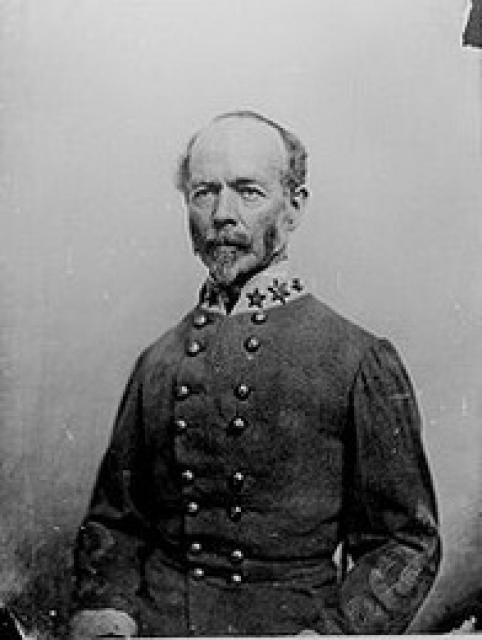
Joseph Eggleston Johnston
 USA
USA- Early Life and Military Career
- The Civil War
- A Rising Star
- The Western Theatre
- Decline and Demise
- Post-War Life
- A Final Tribute
Early Life and Military Career
Joseph Eggleston Johnston was born into a prominent Virginia family in 1807. He entered the United States Military Academy at West Point in 1825, where he graduated in 1829 alongside Robert E. Lee. After serving in the artillery for eight years, Johnston resigned his commission in 1837 only to rejoin the army as a topographical engineer. He distinguished himself during the Mexican War, earning two severe wounds.
The Civil War
Upon the outbreak of the Civil War in 1861, Johnston was the highest-ranking officer to resign from the US Army and join the Confederacy. He initially held several commands within the Confederate Army, including the Shenandoah Army, the Army of the Potomac, and the Department of Northern Virginia.
A Rising Star
Johnston's military prowess shone brightly at the Battle of First Manassas (Bull Run), earning him a promotion to full general. However, he was wounded at the Battle of Seven Pines, paving the way for Lee to assume command of the Army of Northern Virginia.
The Western Theatre
After recovering from his wound, Johnston led the Army of Tennessee in an attempt to relieve John Pemberton's besieged forces in Vicksburg. He also commanded the defense of Fort Jackson on the Mississippi River, facing off against William Sherman for the first time.
Decline and Demise
Persistent setbacks for the Army of Tennessee led to Johnston's replacement by John Hood. Sherman's devastating March to the Sea forced Johnston to take command of three military districts, but Confederate manpower had been depleted. He surrendered to Sherman at Durham Station on April 26, 1865.
Post-War Life
After the war, Johnston settled in Savannah, Georgia, where he engaged in railroad and insurance ventures. From 1879 to 1881, he served as a Democratic Congressman. In 1887, President Grover Cleveland appointed him as Commissioner of Railroads, a position he held until his death in 1891.
A Final Tribute
Johnston never forgot the magnanimity of his surrender to Sherman. At Sherman's funeral in New York City, despite the rain, Johnston marched with his head uncovered out of respect. His subsequent illness and death from pneumonia were attributed to this act. Johnston was buried at Baltimore National Cemetery.



