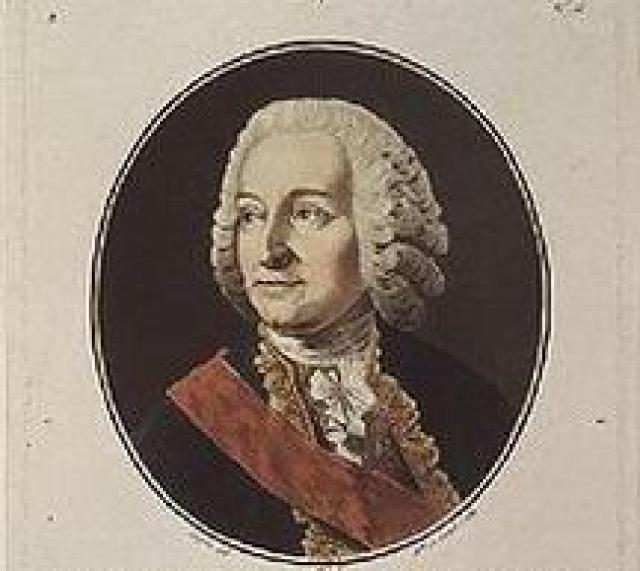
Joseph-Francois Dupleix
 France
- Biography of Joseph-François Dupleix
- Early Life and Naval Career
- Governor of Indostan
- Legacy and Later Life
Biography of Joseph-François Dupleix
Joseph-François Dupleix was a French colonial administrator and general governor in India, and the director of the French East India Company. He began his career as a general consul in Pondicherry in 1720. In 1732, he was appointed as the superintendent of the French factory in Chandernagore, and in 1742, he became the general governor of all French possessions in India. Dupleix played a significant role in the struggle for thrones in Carnatic and Hyderabad, supporting French allies against the English and promoting French influence in South India.
During the War of the Austrian Succession, France proposed a neutral status for India, but the offer was rejected by the English. In 1746, Dupleix captured Madras, the center of the English East India Company in India, but failed to take the nearby Fort St. David. He then pursued a policy of displacing the English from India, but lack of resources and insufficient support from the French government led to the failure of his plans. Ultimately, all French forces were defeated due to the actions of Robert Clive's troops. In 1754, Dupleix was recalled to Paris, where he died in poverty and obscurity.
Early Life and Naval Career
Joseph-François Dupleix ran away from home at the age of 18 and joined the navy as a sailor, embarking on several voyages to North America. In 1720, he was sent to Pondicherry as a military commissioner, where he established himself in India. Gifted with exceptional abilities and energy, he founded a trading company that built 15 ships and chartered 72. His ships sailed the seas of Southeast Asia from the Persian Gulf to the Philippine Islands, undermining British maritime trade. He also built several cities and fortified outposts on the east coast of India.
Governor of Indostan
In 1742, Dupleix was appointed as the governor of Indostan. During the ensuing War of the Austrian Succession, Britain, contrary to France's desire to avoid war in India, sent a fleet under the command of Admiral Peyton to Indian waters and prepared to attack the capital of French possessions. Dupleix, with his initiative and against the will of the Paris government, fortified Pondicherry with his own resources, which not only repelled the English attack but also allowed for a counter-offensive. On July 6, 1746, French forces under the command of Governor-General La Bourdonnais defeated the British fleet in the Battle of Negapatam and occupied Madras. Due to a conflict between two ambitious governors who refused to obey each other, La Bourdonnais accused Dupleix of treason and he was recalled to Paris. Dupleix's alleged betrayal was his agreement with the British to allow them to buy the city for 2 million dollars when surrendering Madras.
With a small detachment of French troops remaining in Madras, Dupleix was forced to fend off attacks from the allied British and Great Mughals, unsuccessfully besieging Fort St. David. In the summer of 1748, a new British fleet under Admiral Boscawen arrived in the theater of war. At the same time, the French colony came under attack from local Indian tribes. Dupleix, barricaded in Pondicherry, withstood a two-month siege. The French showed great courage in defending the fortress, and the British, after several unsuccessful attempts and significant losses, were forced to lift the siege. However, unaware of this, the French government concluded the Treaty of Aix-la-Chapelle in the autumn of 1748, which returned Madras to Britain.
Legacy and Later Life
The signing of the peace treaty was a serious blow to both Dupleix himself and the prestige of France in India. Dupleix's far-sighted policies, which managed to win the support of local princes dissatisfied with British policies in India, did not find support from the Paris authorities. However, Dupleix continued to pursue his own policies and expanded French territories by eliminating the independence of local nabobs and maharajas. By 1752, Dupleix had increased the number of French subjects by 40 million people.
However, Dupleix lacked the financial resources for his ambitious plans. A minor defeat against the Mysore Sultan, secretly supported by the British, was used by Dupleix's enemies, accusing him of ambitious aspirations to create an independent Indian Empire. Moreover, the constant demand for reinforcements and resources frustrated shortsighted ministers of Louis XV, who considered Dupleix the most troublesome governor. When the London Cabinet made the withdrawal of Dupleix from India a condition for maintaining peace in 1754, he was recalled after 30 years of service.
Upon his return to France, Dupleix attempted to reclaim the money spent on military expenses to strengthen the colony during his time in India, but his request was denied. In 1764, Dupleix died in poverty, having lived to witness France losing most of its possessions in India.