Juan Felipe Herrera
 USA
- Childhood and Education
- From Community Work to Poetry
- A Career Across Genres
- Poet Laureate and Public Projects
- Teaching and Later Recognition
- Legacy
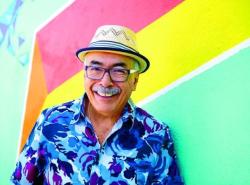
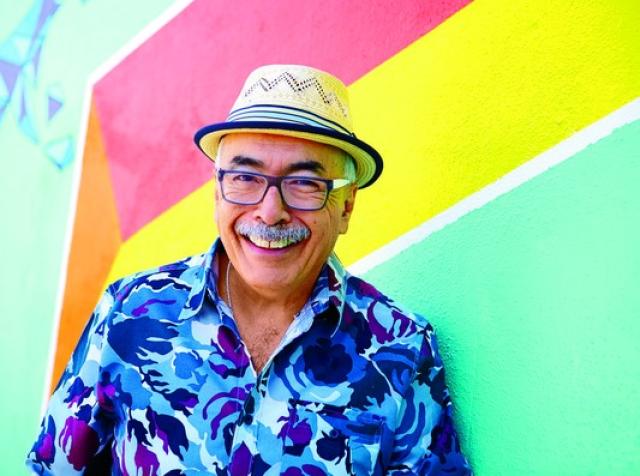
Juan Felipe Herrera’s poetry moves across languages, genres, and borders. The son of migrant farmworkers, he spent his childhood traveling with his family through California’s agricultural communities; decades later, those experiences became central to a body of work shaped by Chicano activism, Indigenous cultures, and the lives of people pushed to society’s margins. In 2015, he became the first Latino to serve as Poet Laureate of the United States.
Childhood and Education
Herrera was born on December 27, 1948, in Fowler, California, to Mexican American migrant farmworkers. As a child, he moved with his parents through the San Joaquin Valley, living in trailers and tents and attending schools in towns from San Francisco to San Diego. The constant movement gave him an early sense of how language and belonging shift from one place to another.
He began drawing cartoons in middle school and became interested in music and performance as a teenager. After graduating from San Diego High School in 1967, he received an Educational Opportunity Program scholarship to attend the University of California, Los Angeles. At UCLA, he studied social anthropology and became involved in the Chicano civil rights movement and experimental theater. He earned his bachelor’s degree in 1972, completed a master’s degree in social anthropology at Stanford in 1980, and later received an MFA from the University of Iowa Writers’ Workshop in 1990.
From Community Work to Poetry
Herrera’s early artistic life was collaborative and public-facing. He worked in performance and community arts and helped build ensembles that brought poetry beyond the page. His interests in Indigenous cultures also led him to organize a Chicano trek to Indigenous Mexican villages, traveling from the rain forests of Chiapas to the mountains of Nayarit. The experience broadened the cultural and historical references in his work.
His first chapbook, Rebozos of Love, appeared in 1974. From the start, he challenged the boundaries between spoken and written poetry, English and Spanish, and personal memory and political history. His poems often combine colloquial speech, vivid imagery, humor, and experimental forms. Rather than keeping his subjects within a single tradition, he draws on Chicano and Indigenous histories, contemporary working life, and the sound of people speaking across languages.
A Career Across Genres
Herrera’s writing has ranged from poetry collections to novels in verse, plays, performance, and books for young readers. Crashboomlove, his 1999 novel in verse, received the Americas Award. Half of the World in Light: New and Selected Poems, published in 2008, won the National Book Critics Circle Award and the PEN/Beyond Margins Award.
Other notable collections include 187 Reasons Mexicanos Can’t Cross the Border: Undocuments 1971–2007, Senegal Taxi, and Notes on the Assemblage. The last reflects on state violence and ends with a call to make art through action. His 2020 collection Every Day We Get More Illegal turns toward the labor and lives of immigrants and others vulnerable to dehumanizing labels.
Herrera has also written extensively for children and young adults. Calling the Doves / El canto de las palomas recalls his childhood in migrant farmworker communities. Upside Down Boy / El Niño de Cabeza was adapted into a musical, while Jabberwalking encourages young readers to experiment with poetry and language. His work for younger audiences shares the curiosity and playfulness of his writing for adults without softening its interest in identity and community.
Poet Laureate and Public Projects
Before his national appointment, Herrera served as California Poet Laureate from 2012 to 2015 and as a Chancellor of the Academy of American Poets. The Library of Congress named him the 21st Poet Laureate of the United States in 2015, and he served through 2017. He was the first Latino to hold the position.
During his tenure, he launched La Casa de Colores, a project inviting people from across the country to contribute to an evolving epic poem. The project reflected his belief that poetry could be a shared civic space, one where people who rarely see their lives represented in literature could add their voices. He made around 130 official appearances during his two terms.
Teaching and Later Recognition
Teaching has been a central part of Herrera’s work. He taught Chicano and Latin American studies at California State University, Fresno, and creative writing at the University of California, Riverside, as well as in community galleries and correctional facilities. He is professor emeritus at both universities.
His honors include the National Book Critics Circle Award, the Los Angeles Times Robert Kirsch Award for lifetime achievement, the Frost Medal for distinguished lifetime achievement in poetry, and a 2024 MacArthur Fellowship. His poem “Sunriders” was engraved on a plaque sent aboard NASA’s Lucy mission in 2021, and a bilingual elementary school in Fresno bearing his name opened in 2022. A 2026 collection, Handful of Gravel: Ukraine Notebook of Voices, 2022–2025, extends his long-standing practice of listening across borders and bringing many voices into a shared poetic space.
Legacy
Herrera’s work has helped widen the possibilities of contemporary American poetry. It can be intimate and political, playful and urgent, rooted in specific Mexican American histories yet open to a wider chorus of voices. His career, from migrant camps and community performance to the Library of Congress, has consistently treated poetry as something people make together—not only something they read on a page.