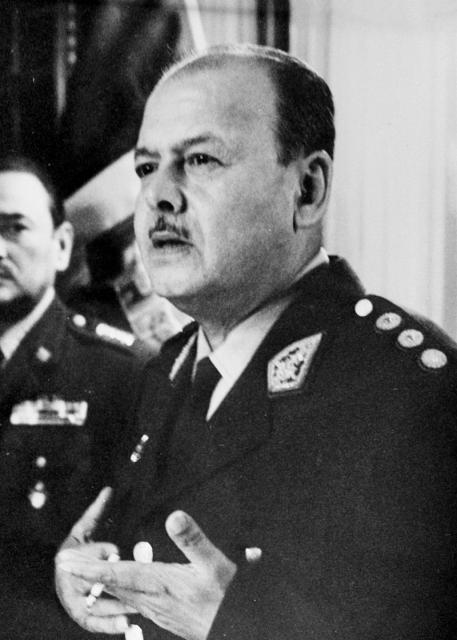
Juan Velasco Alvarado
 Peru
Peru- Juan Velasco Alvarado: A Revolutionary Military Leader
- Rise to Power
- Revolutionary Government of the Armed Forces
- Social and Foreign Policies
- Legacy
Juan Velasco Alvarado: A Revolutionary Military Leader
Early Life and Military CareerJuan Velasco was born in Piura, Peru, in 1910, to a modest family. With ten siblings, his childhood was described as one of "dignified poverty." In 1929, he joined the Peruvian army as an infantryman, where his exceptional discipline earned him selection for the Chorrillos Military School. He graduated in 1934, embarking on a successful military career.
Rise to Power
President Fernando Belaúnde's lack of congressional support hindered his authority, leading to frequent conflicts with parliament and instability in society. In August 1968, Belaúnde's administration resolved a long-standing dispute with the Standard Oil of New Jersey, but the public outcry over compensation payments forced his resignation. The disappearance of a page from the contract, implicating Belaúnde, sealed his fate. Days later, Belaúnde was overthrown by a military coup led by Juan Velasco.
Revolutionary Government of the Armed Forces
Velasco established the Revolutionary Government of the Armed Forces, a leftist administration aimed at improving the lives of the poor. Immediately after the coup, key industries, including oil, fishing, mining, and telecommunications, were nationalized. State-owned monopolies were created to prevent private interference.
The government promoted anti-capitalist ideals, introducing new national holidays and implementing press censorship. Several radio stations were closed, and newspaper publishers were exiled.
Velasco's core policy was an agrarian reform program modeled after Soviet collectivization. Landowners were expropriated, receiving bonds in return, which sparked discontent as they feared the bonds would become worthless due to inflation.
Social and Foreign Policies
Velasco's government took steps to empower the indigenous Quechua and Aymara populations. Quechua was recognized as Peru's second official language in 1975, and it became the language of a television channel and radio stations.
Peru's foreign policy shifted away from the West and towards the Soviet bloc. Agreements were signed with the Soviet Union, granting Soviet fishing rights in Peru's waters. Soviet advisers were invited, and the American Peace Corps was expelled in 1973. Relations with the US soured, particularly due to the nationalization of American-owned businesses.
Legacy
Velasco's presidency left a controversial legacy. While his reforms aimed to redistribute wealth and empower marginalized groups, they also faced criticism for economic instability and authoritarianism. His administration's impact on the Peruvian military and society continues to be debated today.