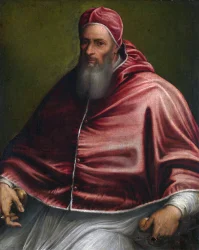
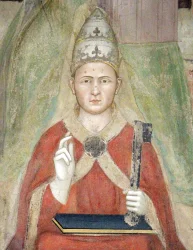
Julius III
- A churchman shaped by Rome
- A compromise pope and the Council of Trent
- Politics and patronage
- Final years and legacy
Pope Julius III inherited the work of reforming the Catholic Church during a time of religious upheaval and European rivalry. He is remembered for reopening the Council of Trent, supporting the Jesuits, and bringing Catholicism back to England under Queen Mary I. Yet his papacy also drew criticism for political inconsistency and favoritism toward relatives. His rule was a study in contrasts: a pope who backed important reform institutions while struggling to live up to the reforms he endorsed.
A churchman shaped by Rome
Born Giovanni Maria Ciocchi del Monte in Rome on September 10, 1487, he came from a family of lawyers. He studied law at Perugia and Siena and theology under the Dominican scholar Ambrosius Catharinus. His career moved through a succession of church offices: he became archbishop of Siponto in 1512, bishop of Pavia in 1520, and a senior administrator in the Papal States. He was in Rome during its 1527 sack and was briefly taken hostage before being secretly freed.
Pope Paul III made him a cardinal in 1536. Del Monte then became one of the key figures preparing the Council of Trent, the gathering called to address church reform and the Protestant Reformation. As one of its presidents, he opened the council in December 1545. He later supported transferring the sessions to Bologna, a move that brought him into conflict with Emperor Charles V, who preferred Trent.
A compromise pope and the Council of Trent
After Paul III died, cardinals spent ten weeks divided among French, imperial, and Farnese factions. Del Monte became the compromise candidate and was elected on February 7, 1550. He took the name Julius III.
One of his first major priorities was restarting the Council of Trent, which had been suspended and moved to Bologna. In 1550 he ordered it back to Trent, where sessions resumed in May 1551. The council addressed doctrine and reform, but its work was interrupted by the wars between France and the Habsburgs and by disputes over who would attend. French bishops did not take part, and the emperor’s forces faced military setbacks. Julius suspended the council in April 1552. It would not meet again until a later pontificate.
The pope also supported a growing religious order with an expanding educational mission. He confirmed the Society of Jesus in 1550 and, at the request of Ignatius of Loyola, approved the Collegium Germanicum in Rome in 1552. The college trained priests for German-speaking lands at a time when Catholic leaders feared that the Reformation was gaining ground there. Julius also sent Cardinal Reginald Pole to England after Mary Tudor restored Catholic rule.
Politics and patronage
Julius’s political alliances shifted as circumstances changed. He first accepted the restoration of Parma to Ottavio Farnese, then turned against Farnese when the duke aligned with France. The resulting conflict drew the pope toward Charles V and brought war to the Papal States. After military failures, Julius made a truce with France in 1552 and largely withdrew from Italian power struggles.
His record on reform was also uneven. Julius encouraged new institutions and appointed commissions to study church reform, but many proposals remained unfinished. He granted the cardinal’s red hat to Innocenzo del Monte, a young man adopted by the pope’s brother, and bestowed other offices and benefits on relatives. The appointments were widely criticized as nepotism and became the most damaging stain on his reputation.
Final years and legacy
Julius spent much of his later life at Villa Giulia, the elegant residence he built in Rome. He died on March 23, 1555, before a planned reform bull could be issued. The Council of Trent was still unfinished, but its brief return under his authority kept the process alive.
Julius III’s legacy rests on that mixture of accomplishment and contradiction. By reopening the council and supporting Jesuit education, he helped shape the Catholic response to a divided Europe. By advancing his own family, he exposed the distance between church reform as an ideal and the politics of papal power.