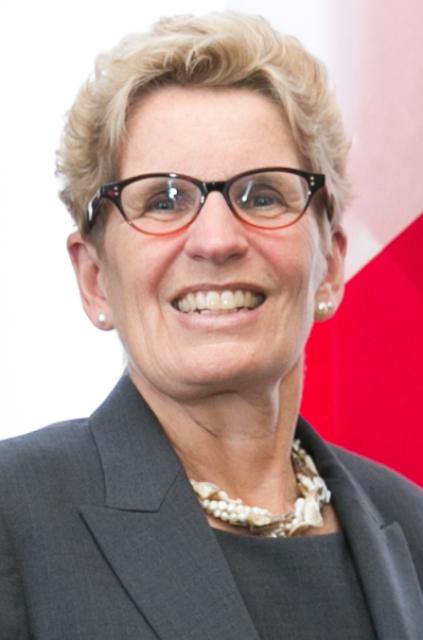
Kathleen Wynne
 Canada
Kathleen Wynne is a Canadian educator and politician who became Ontario’s first woman premier and Canada’s first openly gay premier. Before taking office, she built a career in education, community organizing, and provincial politics. As premier from 2013 to 2018, she led the Ontario Liberals through a majority election victory and a second campaign that ended in a sweeping defeat, leaving a complex record of social programs, public-sector decisions, and political debate.
Early life and education
Kathleen O’Day Wynne was born on 21 May 1953 in Richmond Hill, Ontario. She studied at Queen’s University and the University of Toronto, where she earned a master’s degree in linguistics in 1980. She later completed a master’s degree in education and counselling psychology at the Ontario Institute for Studies in Education.
Before entering elected office, Wynne worked as a community mediator and became involved in local education advocacy. She helped organize parent groups and served as a public school trustee in Toronto. Publicly funded education remained a defining interest throughout her career, influencing her work as both an education minister and premier.
Wynne has three children from her first marriage and later built a life with her partner, Jane Rounthwaite. Her personal life also became part of her public story: she was open about being a lesbian, and her election as premier marked a historic milestone in Canadian politics.
Entering provincial politics
Wynne was elected as the member of provincial parliament for Don Valley West in 2003. She joined the Liberal government of Dalton McGuinty and held several cabinet positions, including minister of education, transportation, agriculture and food, municipal affairs and housing, and Aboriginal affairs. Her years in government gave her experience across education, infrastructure, rural issues, and relations between provincial and local governments.
As education minister, she supported measures including full-day kindergarten and efforts to reduce class sizes. Her tenure also involved contentious curriculum questions, including revisions to Ontario’s sex education curriculum. Wynne’s work combined a focus on public services with an approach shaped by negotiation and coalition-building, skills she had practiced as a mediator.
Premier of Ontario
In January 2013, Wynne became leader of the Ontario Liberal Party, succeeding McGuinty. She was sworn in as premier on 11 February 2013, becoming Ontario’s 25th premier, its first woman to hold the office, and the first openly gay premier in Canada. In the 2014 provincial election, she led the Liberals to a majority government.
Her government pursued a broad agenda that included infrastructure investment, education and childcare programs, and new workplace standards. A prominent change raised Ontario’s minimum wage to $14 an hour in January 2018, with a planned increase to $15 the following year. The government also introduced free tuition for many low-income students and expanded access to prescription drug coverage for young people.
Other decisions drew sustained criticism. The partial sale of Hydro One, Ontario’s electricity transmission company, became a major political controversy, with opponents objecting to the privatization of a public asset and questioning the effect on electricity costs. The government’s response to rising electricity bills, its spending choices, and its fiscal record also became central issues in the 2018 campaign. These debates shaped public perceptions of Wynne’s premiership alongside its social-policy initiatives.
Defeat and later work
The 2018 election brought a sharp reversal. The Liberals fell from a majority to seven seats, losing official party status in the legislature. Wynne narrowly retained Don Valley West but resigned as party leader on election night. She continued serving as an MPP until 2022, when she did not seek re-election, ending nearly nineteen years in the provincial legislature.
After leaving elected office, Wynne remained active in discussions of education and public policy. She became a distinguished fellow at the University of Toronto’s Munk School of Global Affairs and Public Policy, speaking with students and drawing on her experience in government and community work.
Legacy
Wynne’s place in Ontario history rests on both her landmark election and the policies and controversies of her government. Her premiership widened the range of people who could imagine themselves in the province’s highest office. It also showed how quickly a long-governing party could lose public support amid dissatisfaction with its record. Her work in education, leadership during a period of social change, and candid public identity continue to inform discussions about representation and political leadership in Canada.