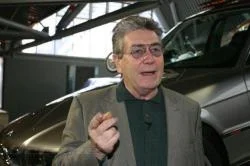
Kazuki Akane
- From Production Runner to Director
- A New Vision of Escaflowne
- Original Worlds and Adaptations
- A Continuing Career
Kazuki Akane has spent four decades moving through the many jobs that make an animated series: production, storyboards, episode direction, writing and finally the overall vision. He became known internationally with The Vision of Escaflowne, then kept returning to original projects that mix science fiction or fantasy with the intimate emotions of young characters. His work remains part of the anime conversation: in March 2026, he joined the cast and crew at a Sunrise event celebrating the Escaflowne film.
From Production Runner to Director
Born in Osaka on March 24, 1962, Akane graduated from Chiba Institute of Technology and joined Sunrise in 1985. He began as a production runner on major projects including Mobile Suit Gundam ZZ and Mobile Suit Gundam: Char’s Counterattack. The role put him close to the demanding practical side of animation production before he began working in storyboards and direction.
In 1988, he moved into episode direction on Ronin Warriors. Over the next several years, he worked on projects such as Jushin Liger and Mobile Suit Gundam 0083: Stardust Memory, building experience across action, science fiction and fantasy. His first major opportunity to direct a full series came in 1996, when Sunrise placed him at the helm of The Vision of Escaflowne.
A New Vision of Escaflowne
Created with Shoji Kawamori, Escaflowne follows high-school student Hitomi Kanzaki, who is transported to the war-torn world of Gaea. The series brings together giant-robot battles, fantasy kingdoms, romance and a heroine’s inner life. Its distinctive visual design and emotional approach set it apart from the more conventional mecha shows of its era, and helped it find an audience beyond one genre or demographic.
Akane later explained that he wanted a female lead who could act for herself instead of simply being protected. He suggested that character designer Nobuteru Yuki give Hitomi short hair, reflecting the independent, active heroine he wanted to see on screen. The series’ combination of sweeping fantasy and vulnerable teenage perspective became one of the clearest signatures of his directing.
Akane returned to the world of Escaflowne for the 2000 theatrical film, which reimagined its characters and story in a darker, more compressed form. He later acknowledged that the film’s shift in tone could be jarring for viewers who loved the television series, but said that revisiting it years later made him appreciate what the production had attempted.
Original Worlds and Adaptations
After leaving Sunrise around 2000, Akane worked with Satelight and expanded his range as a creator. He directed Geneshaft (2001) and created and directed Heat Guy J (2002), then took on one of his most personal projects with Noein: To Your Other Self (2005). For Noein, he served as creator, director and series composer, building a story about parallel realities, friendship and the anxieties of adolescence.
He continued to move between original concepts and adaptations. At A-1 Pictures, he directed Birdy the Mighty: Decode (2008), a new take on Masami Yūki’s science-fiction manga. From 2012 to 2016, he directed and wrote the five-part Code Geass: Akito the Exiled, a European-front story connected to the Code Geass universe. The project let him bring the scale of military science fiction together with characters caught in a conflict larger than themselves.
In 2019, Akane directed Stars Align, a drama centered on a middle-school soft-tennis club and the complicated lives of its members. He has also continued contributing storyboards to other directors’ productions, a return to the collaborative craft that began his career.
A Continuing Career
Akane’s filmography moves between large-scale spectacle and the private feelings of young people. Even in worlds built around mecha, alternate dimensions or political conflict, he often anchors the action in characters trying to find agency and connection. His collaborators have included composer Yoko Kanno and designer Nobuteru Yuki on Escaflowne, among many artists across the studios where he has worked.
Sunrise’s 2026 anniversary presentation brought Akane back to Escaflowne, decades after the series established him as a director. At the event, he reflected on the theatrical film and the distance time had given him from its original reception. It was a fitting return for a filmmaker whose work has kept moving between ambitious original ideas and the shared worlds of Japanese animation.