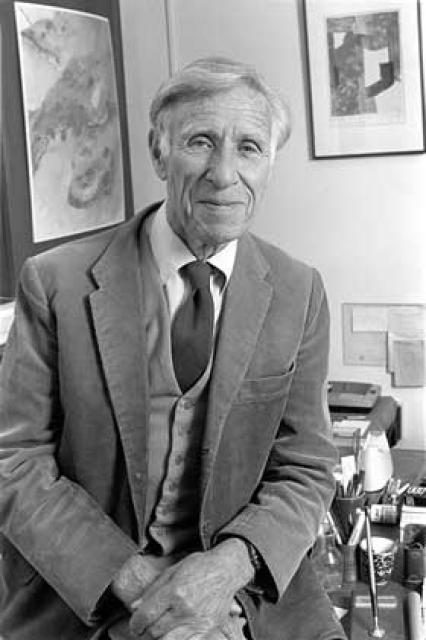
Konrad Bloch
 USA
USABiography of Konrad Bloch
Konrad Bloch was a German-American biochemist and the recipient of the Nobel Prize in Physiology or Medicine in 1964. He was born in Neisse, Germany in 1912. After completing his education at a local high school, he moved to Munich to study chemistry at the Technical University. It was there that he developed a passion for organic chemistry, particularly the structure of natural substances.
During his studies, Bloch attended lectures at the Munich Chemical Society, where he was exposed to the works of renowned organic chemists such as Adolf Windaus, Heinrich Wieland, and Rudolf Willstätter. In 1934, he obtained a bachelor's degree in applied chemistry. However, his time in Munich came to an end as Adolf Hitler became the Chancellor of Germany in 1933. Being Jewish, Bloch decided to emigrate.
Fortunately, he found temporary work at the Swiss Institute for Experimental Cancer Research in Davos. It was there that he conducted his first scientific research on the phospholipids of the tuberculosis bacillus. In 1936, Bloch immigrated to the United States, following the advice of Max Bergmann and with substantial support from the Rockefeller Foundation. He enrolled in the biochemistry department at the College of Physicians and Surgeons of Columbia University and obtained his doctoral degree in 1938.
During this time, Bloch had the opportunity to work with Rudolf Schoenheimer, whose research group influenced his scientific interests. He became increasingly fascinated with the problems of intermediary metabolism and biosynthesis. In 1942, Bloch and his colleague David Rittenberg began their studies on the biological synthesis of cholesterol, which became their focus for the next two decades. Cholesterol, a complex molecule consisting of 27 carbon atoms and four rings, plays a crucial role in various biological processes.
In 1946, Bloch moved to Chicago after receiving an offer to join the University of Chicago as an assistant professor of biochemistry. He quickly advanced to become an adjunct professor in 1948 and a full professor in 1950. During his time at the University of Chicago, he worked under the guidance of E.A. Evans, who led a talented group of like-minded scientists that generated numerous innovative ideas. Bloch continued his research on cholesterol synthesis and also collaborated with Jay Snell on the synthesis of the tripeptide glutathione, an essential component for cellular function.
In 1953, Bloch received a Guggenheim Fellowship and spent a year conducting research at the Institute of Organic Chemistry in Zurich. Inspired by his experience in Switzerland, he returned to the United States and became a professor of biochemistry at Harvard University in 1954.
Through his research, Bloch discovered that the key building block of cholesterol is the chemically active form of acetate called acetyl-CoA. Acetyl-CoA is converted into mevalonic acid, which then transforms into isoprene, a hydrocarbon compound that eventually leads to the synthesis of cholesterol. Bloch's work shed light on the relationship between cholesterol levels in the body and the formation of cholesterol plaques on arterial walls, contributing to our understanding of atherosclerosis.
In recognition of his groundbreaking discoveries, Konrad Bloch, along with Feodor Lynen, received the Nobel Prize in Physiology or Medicine in 1964 for their contributions to the mechanisms and regulation of cholesterol and fatty acid metabolism.
Throughout his career, Bloch was a member of several prestigious scientific organizations, including the American Chemical Society, the National Academy of Sciences, the American Academy of Arts and Sciences, the American Society of Biochemists, and the Harvey Society. He served as the President of the American Society of Biochemists in 1967 and held various leadership positions within the scientific community.
Bloch's numerous awards and honors include the Medal of the American Society of Biochemists, the Fritzsch Award from the American Chemical Society, the William Lloyd Evans Award from Ohio University, and honorary doctorates from universities in Uruguay, Brazil, Nancy, and Columbia University.
Konrad Bloch's contributions to the field of biochemistry have had a lasting impact on our understanding of cholesterol metabolism and its implications for human health. His pioneering research continues to inspire scientists in the quest for new treatments and preventative measures against cardiovascular diseases.