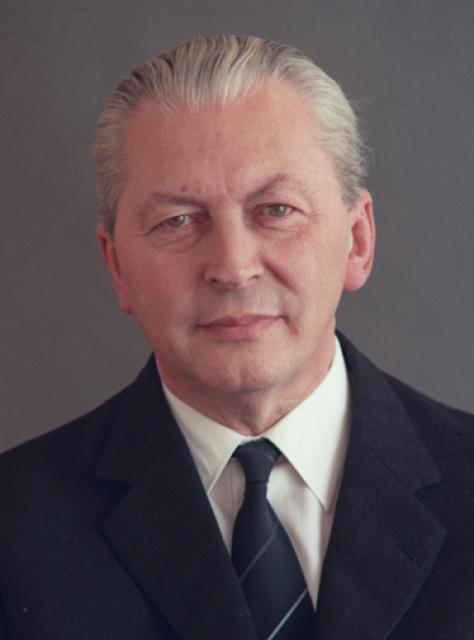
Kurt Georg Kiesinger
 Germany
- Early Life and Education
- Nazi Party Involvement and Denazification
- Political Reemergence and Rise to Prominence
- The Grand Coalition and Kiesinger's Chancellorship
- Economic and Social Policies
- Foreign Policy and Ostpolitik
- Decline and Legacy
Kurt Georg Kiesinger: From Nazi Propagandist to Chancellor of West Germany
Kurt Georg Kiesinger, born in 1904, embarked on a tumultuous political career that would culminate in him becoming the third Federal Chancellor of West Germany from 1966 to 1969. His journey, marked by both controversy and compromise, is a reflection of Germany's complex postwar history.
Early Life and Education
Kiesinger hailed from a humble background in Ebigen, Württemberg. He initially pursued literary interests, writing poetry and publishing a small collection. However, he later shifted to academia, studying pedagogy, philosophy, and literature at the University of Tübingen. He completed his education at the University of Berlin, focusing on law.
Nazi Party Involvement and Denazification
In 1933, Kiesinger joined the Nazi Party. His oratorical skills earned him a position in the Ministry of Propaganda, a fact that would haunt him later in life. After the war, he was interned by American forces for 18 months. Upon his release, he underwent denazification and was cleared.
Political Reemergence and Rise to Prominence
In 1948, Kiesinger joined the Christian Democratic Union (CDU) and became a member of the Bundestag in 1949. His eloquence made him a sought-after speaker, but his Nazi past hindered his political advancement. In 1958, he assumed the role of Minister-President of the state of Baden-Württemberg.
The Grand Coalition and Kiesinger's Chancellorship
In 1966, the West German government faced a budget deficit. Chancellor Ludwig Erhard's proposal to increase taxes was met with opposition from their coalition partner, the Free Democratic Party (FDP). The CDU/CSU, lacking an absolute majority, sought a new alliance. Unexpectedly, the Social Democrats (SPD), traditional opposition, agreed to join the government on the condition that Erhard not be chancellor.
Christian Democrats considered several candidates before settling on Kiesinger, seen as a compromise figure. Despite his Nazi background, he became Chancellor of the "Grand Coalition" on December 1, 1966.
Economic and Social Policies
During Kiesinger's tenure, the German economy continued to grow. Unemployment remained low, and the government implemented measures to support workers and tackle housing shortages. The influx of "guest workers" from abroad provided additional labor.
Foreign Policy and Ostpolitik
Foreign policy under Kiesinger witnessed a shift towards European integration and a more nuanced approach to "Ostpolitik" with Eastern Europe. Social Democratic leader Willy Brandt, who served as Vice-Chancellor and Foreign Minister, played a key role in these developments. However, the Soviet invasion of Czechoslovakia in 1968 tempered progress in Ostpolitik.
Decline and Legacy
As elections approached in 1969, Kiesinger and his party campaigned on a platform of stability. However, the SPD and FDP formed a coalition, ending the Grand Coalition. Kiesinger continued to serve as Chairman of the CDU until 1971 and as a member of the Bundestag until 1980.
Kurt Georg Kiesinger died in obscurity in 1988. His legacy remains a complex one, marked by both his Nazi past and his role as Chancellor during a pivotal period in West German history.


