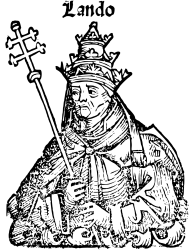
Lando
Lando, also recorded as Landus, became pope in 913 and died in 914 after a short and poorly documented pontificate. The surviving accounts identify him as a native of the Sabina, the region northeast of Rome, and name his father as Taino. With so little contemporary evidence, much of his personal story and the political circumstances of his election remain uncertain.
Early Life and Background
The Liber Pontificalis, the principal medieval source for early papal biographies, gives only a few details about Lando: his Sabine origin and his father’s name. Later accounts sometimes describe Taino as a count, but the evidence does not support a confident reconstruction of Lando’s family history. His birth date is unknown.
Papacy
Lando succeeded Anastasius III in 913. The exact dates of his election and death differ among historical lists, though his pontificate is generally placed between the summer or autumn of 913 and early 914. One medieval list assigns him a reign of about six months; the limited records make its precise length difficult to establish.
Almost nothing is known about his actions in Rome or the wider church. A grant associated with the Sabina region is sometimes identified as the sole recorded act connected with his pontificate, but its details come through later documentation. No sustained account of Lando’s policies or relations with the influential Roman families of the period survives.
Legacy
Lando’s obscurity reflects the thin documentary record for the papacy in the early tenth century. He was followed by John X, and his brief tenure left little trace in the historical narrative. The few facts that can be stated with confidence—his Sabine origin, his father’s name, and his short reign—remain the outline of his biography.