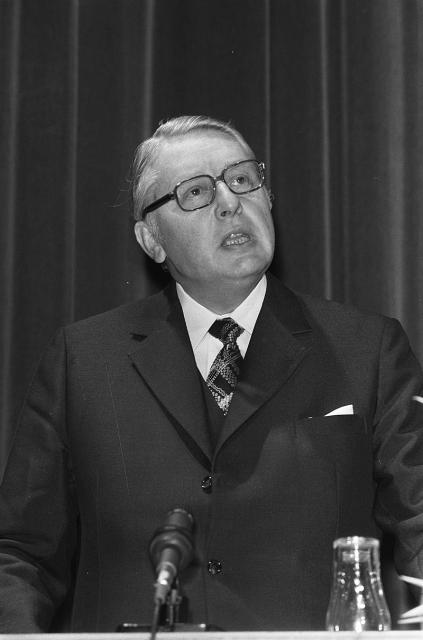
Lauritz Lauritzen
 Germany
- Lauri Lauritzen: A German Politician and Statesman
- Career in Government
- Political Affiliations
- Federal Parliament (Bundestag)
- Ministerial Posts
- Legacy
Lauri Lauritzen: A German Politician and Statesman
Early Life and EducationLauri Lauritzen was born in Plön, Germany, in 1909. After completing his secondary education in 1929, he pursued a law degree at the universities of Freiburg and Kiel. His academic mentor was renowned sociologist Ferdinand Tönnies. Lauritzen earned his first state law examination in 1933 and his doctorate in 1936. He passed his second state law examination in 1937.
Career in Government
From 1937 to 1945, Lauritzen worked in the Chemistry Administration in Berlin. In 1945, he became Head of the Chancery for Schleswig-Holstein Prime Minister Theodor Steltzer. From 1946 to 1950, he served as State Director in the Schleswig-Holstein Ministry of the Interior. In 1953-1954, he was Ministerial Director in the Ministry of the Interior of Lower Saxony.
Political Affiliations
Lauritzen joined the Social Democratic Party (SPD) in 1929. After the party was banned in 1934, he was briefly a member of the Nazi paramilitary SA. However, he never affiliated with the NSDAP, the Nazi Party. Instead, he joined the National Socialist League of Lawyers and the National Socialist People's Welfare Organization.
From 1955 to 1963, Lauritzen was a member of the SPD district executive in Hesse-Nord. From 1969 to 1971, he served on the SPD state board for Schleswig-Holstein.
Federal Parliament (Bundestag)
Lauri Lauritzen represented the SPD in the German Bundestag from 1969 until his death. Initially elected from the Plön constituency, he later represented Schleswig-Holstein on the party list.
Ministerial Posts
Lauritzen's career in government culminated in several prominent ministerial positions. From 1953 to 1964, he was Mayor of Kassel. From 1963 to 1966, he served as Hessian Minister for Federal Affairs and Justice in Georg August Zinn's government.
In 1966, Lauritzen became Federal Minister for Housing and Urban Development in Kurt Georg Kiesinger's grand coalition government. He retained this post in Willy Brandt's cabinet after the 1969 elections, changing the name of his ministry to Federal Ministry for Urban Development and Housing.
In 1972, Lauritzen was appointed Federal Minister for Post and Telecommunications, as well as Federal Minister for Transport. However, after the 1972 elections, he focused exclusively on the Ministry of Transport.
Legacy
During the 1973 oil crisis, Lauri Lauritzen introduced a 100 km/h speed limit on German autobahns. He resigned from government in 1974 following Willy Brandt's resignation as Chancellor.
Lauri Lauritzen passed away in 1975. He is remembered as a dedicated politician who made significant contributions to German society and infrastructure.