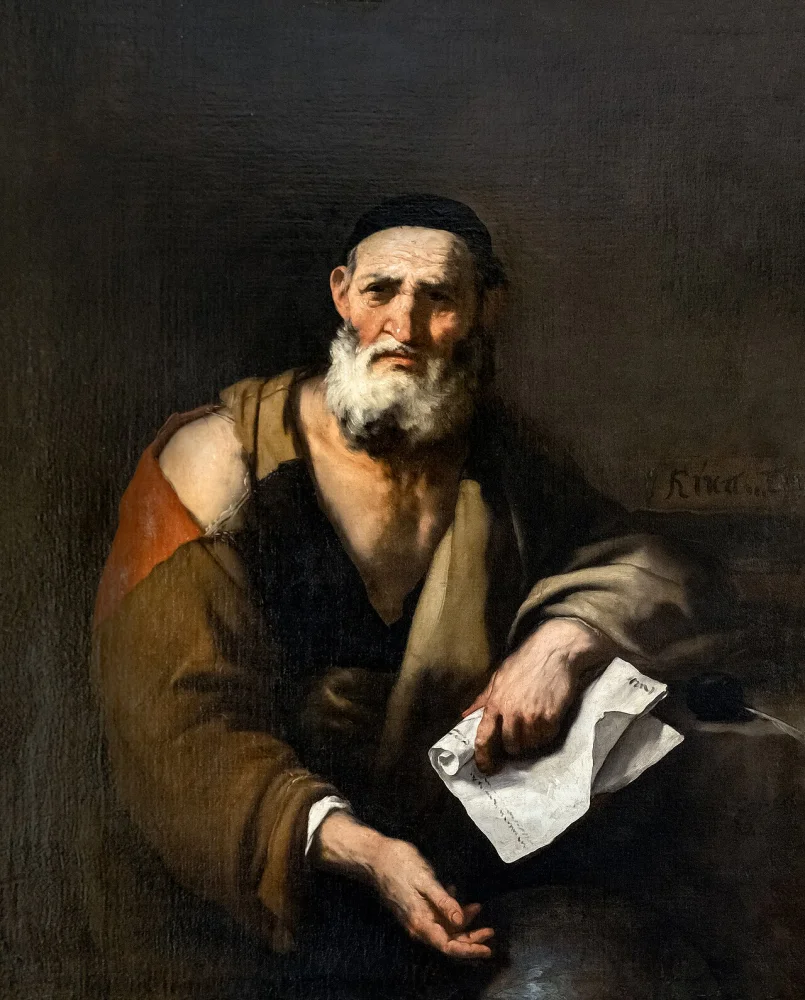
Leucippus
Leucippus was a fifth-century BCE Greek philosopher traditionally credited with founding atomism, the theory that the world consists of indivisible bodies moving through empty space. Almost nothing is known about his life, and even his existence was questioned in antiquity. His historical importance comes chiefly from the role Aristotle and other ancient writers assigned him in the origins of atomist thought.
A shadowy figure
Ancient accounts offered competing birthplaces for Leucippus, including Miletus, Elea, and Abdera. The sources also place him in the fifth century BCE, but they do not provide a dependable chronology. Later tradition made him the teacher of Democritus, the better-known philosopher from Abdera. The connection is plausible within the ancient account of atomism’s development, although the surviving evidence does not allow historians to separate their ideas with confidence.
No complete work by Leucippus survives. Some titles were associated with him in later sources, but the attribution and contents are uncertain. As a result, his biography is largely a history of the ideas attached to his name rather than a record of his personal life.
The beginnings of atomism
Aristotle and his successor Theophrastus treated Leucippus as the founder of the atomist school, often discussing his views together with those of Democritus. The atomists proposed that reality consists of atoms and the void. Atoms were understood as solid, indivisible bodies that differ in shape and arrangement; the void is the empty space that allows them to move and combine.
This theory addressed a major philosophical problem: how change and motion can occur. Some earlier thinkers had argued that true being could not come into existence or pass away. The atomists answered that visible changes arise when enduring particles rearrange. What appears to be coming into being or destruction is, at the underlying level, a new combination or separation of atoms.
The approach offered a natural account of the world without relying on divine intervention to explain every event. Yet the ancient theory was not identical to modern atomic physics. It was a philosophical account of matter, motion, and change rather than an experimental science based on laboratory evidence.
Legacy
Leucippus’s reputation was bound to that of Democritus, whose writings and influence were far greater. Later writers sometimes credited Democritus alone, while others preserved Leucippus as the originator of their shared system. The philosopher Epicurus reportedly questioned whether Leucippus had existed at all, illustrating how uncertain the tradition had become even in antiquity.
Despite these doubts, Aristotle’s testimony gives strong reason to take Leucippus seriously as an early atomist. His place in the history of philosophy is therefore both foundational and elusive: he is remembered as the thinker who helped establish atomism, while the details of his own life and precise contribution remain beyond reliable recovery.

