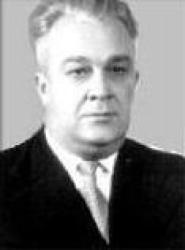
Lev Kuzin
- Early Life and Education
- Career in Research and Development
- Academic Pursuits
- Contributions to Technical Cybernetics
- Pioneer in Interactive Computing
- Database and Knowledge Base Research
- Intelligent Computing
- Later Years
Early Life and Education
Lev Timofeevich Kuzin obtained his Candidate of Technical Sciences degree in radiophysics in 1951.
Career in Research and Development
For 15 years, Kuzin worked as a leading researcher at a military research institute, earning his Doctor of Philosophy and Doctor of Technical Sciences degrees. Subsequently, he spent a decade fulfilling a government commission in technical cybernetics.
Academic Pursuits
Recognizing the need for better engineering education, Kuzin transitioned to teaching at a pedagogical institute. In 1963, he joined the Moscow Engineering Physics Institute (MEPhI) and established the Department of "Control Electronic Computing Machines," later renamed the Department of Cybernetics.
Contributions to Technical Cybernetics
Kuzin's innovative approach to technical cybernetics earned him the USSR State Prize. His emphasis on balancing engineering and theoretical foundations laid the groundwork for the training of engineers and developers of technical systems.
Pioneer in Interactive Computing
Inspired by the growing significance of automated computations, Kuzin shifted his focus to computers in the 1970s. He initiated a project on data banking that advanced artificial intelligence research in Russia.
Database and Knowledge Base Research
In the early 1970s, Kuzin's interests expanded to include databases and knowledge bases. He authored a book on mathematical foundations of cybernetics and developed a conceptual framework for representing and extracting knowledge.
Intelligent Computing
Throughout the 1980s, Kuzin's research focused on intelligent computing and database systems. His concept of an "Intelligent Database" integrated human experts with artificial intelligence techniques.
Later Years
From the mid-1980s, Kuzin continued to push the boundaries of information technology. He supported the development of lambda calculus and its applications to data models.