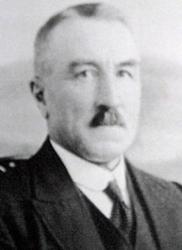
Lorenz Schwietz
 Poland
- Born in Silesia
- Training Under Julius Krautz
- Appointment as Prussian Executioner
- Partition of Duties
- The Execution Ritual
- Financial Ruin and Despair
Born in Silesia
Lorenz Schwitz was born on July 25, 1850, in a small town called Groß Döbern, nestled within Silesia, a Prussian province. From a young age, he pursued a career as a butcher, gaining experience in Breslau and Racibórz, both within his native Silesia.
Training Under Julius Krautz
In 1886, Schwitz became superintendent of slaughterhouses in Breslau, while also serving as an assistant to the royal executioner, Julius Krautz. Krautz, hailing from Charlottenburg, was forced to resign after a fatal altercation with his assistant, Gummich, in 1889. Schwitz was initially considered for the position of chief executioner of Breslau, but his history of petty offenses led to his disqualification.
Appointment as Prussian Executioner
With the retirement of the Reindels, a dynasty of executioners, in 1898 and 1901, Schwitz passed the proficiency test and was appointed as the Prussian executioner on June 21, 1900. His first executions took place on August 8 and 9, 1900.
Partition of Duties
To manage the workload, the Ministry of Justice divided Prussia into two regions: East Prussia for Schwitz and West Prussia for Alwin Engelhardt. However, Engelhardt's poor performance led to his dismissal in 1906, leaving Schwitz as the sole executioner for the kingdom.
The Execution Ritual
Schwitz's execution squad consisted of three to four assistants (some of whom later became executioners themselves), a red bench, an ax, a log, and a black bowler hat. They traveled to execution sites by third-class train, with expenses covered by the state. The executioner and the condemned would meet the evening before the execution, where Schwitz would assess the victim's neck and conduct a mental and physical examination to prevent any resistance. He would then inscribe the victim's name on his execution ax, which is now preserved in a Berlin museum. Schwitz claimed to feel no remorse, seeing his duty as merely carrying out justice.
Financial Ruin and Despair
The loss of his wife in 1923 and the economic crisis in Weimar Germany consumed Schwitz's savings. Desperate to alleviate his financial woes, he published a memoir in 1924, but it brought neither solace nor financial gain. Deeply troubled, Schwitz ended his life by suicide in May 1925.