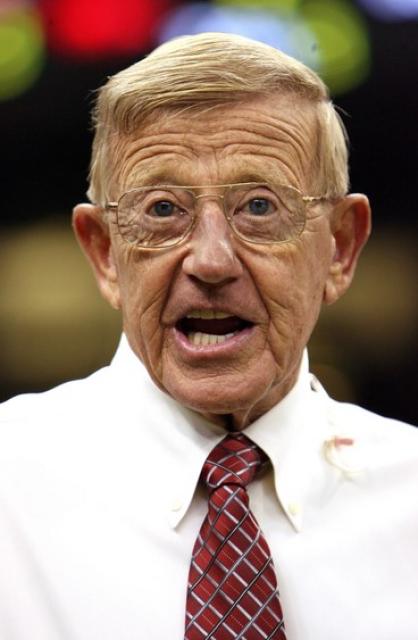
Lou Holtz
 USA
- Early Life and Coaching Beginnings
- Notre Dame and the 1988 Championship
- Television, Public Life, and Family
Lou Holtz was one of college football’s most recognizable coaches, a sharp-witted motivator whose teams became known for discipline, resolve, and dramatic turnarounds. Over a career spanning more than four decades, he led six college programs to bowl games and won 249 games as a college head coach. His most celebrated achievement came at Notre Dame, where he guided the Fighting Irish to an undefeated 1988 season and the national championship. Holtz died in 2026 at age 89.
Early Life and Coaching Beginnings
Born Louis Leo Holtz in Follansbee, West Virginia, in 1937, he grew up in East Liverpool, Ohio, in a working-class family. His father drove buses and took on other jobs, and Holtz often recalled the modest circumstances of his childhood as a lesson in hard work. At East Liverpool High School he played football, then attended Kent State University, where he was a linebacker and earned a history degree in 1959. He later completed a master’s degree at the University of Iowa while working as a graduate assistant.
Holtz moved through assistant coaching jobs at William & Mary, Connecticut, South Carolina, and Ohio State. With Ohio State, he was part of the staff for the 1968 national championship team. In 1969, William & Mary gave him his first head-coaching job. He won the Southern Conference in his first season and soon established a reputation for rebuilding teams quickly.
At North Carolina State, he led the Wolfpack to a 33-12-3 record over four seasons and the 1973 Atlantic Coast Conference championship. He then took his only professional coaching job, with the New York Jets in 1976. The season ended with a 3-10 record, and Holtz resigned before the final game, later joking that he was not meant to coach in the pros.
Holtz returned to college football at Arkansas in 1977. His Razorbacks won 60 games in seven seasons, reaching six consecutive bowl games. The team’s 31-6 upset of Oklahoma in the 1978 Orange Bowl became one of the signature wins of his tenure. After two seasons at Minnesota, where he helped lift the program to bowl eligibility, he accepted the Notre Dame job.
Notre Dame and the 1988 Championship
Holtz took charge of Notre Dame in 1986 and soon restored the program to national prominence. In 1988, the Fighting Irish went 12-0, defeating West Virginia in the Fiesta Bowl to secure the national championship. The run began a 64-9-1 stretch, included a 23-game winning streak, and brought nine consecutive bowl appearances. Holtz coached Heisman Trophy winner Tim Brown and other future stars, while instilling habits that became closely associated with his teams.
He also left visible marks on the school’s football culture. During his tenure, the locker room’s “Play Like a Champion Today” sign was introduced, and player names were removed from the backs of jerseys to stress the team over individual recognition. Holtz finished his Notre Dame career after the 1996 season with 100 wins. He was inducted into the College Football Hall of Fame in 2008.
After two years as a television commentator, Holtz returned to coaching in 1999 at South Carolina. The Gamecocks went 0-11 in his first season, then improved to 8-5 the next year and upset Ohio State in the Outback Bowl. The striking turnaround earned him national coach of the year honors. He retired from coaching after the 2004 season with a 249-132-7 college record across six programs.
Television, Public Life, and Family
Holtz became a familiar face to football fans through his work as a CBS and later ESPN analyst. His exuberant delivery, aphorisms, and quick humor made him a popular speaker as well as a television personality. He wrote and co-wrote books on leadership, faith, and achievement, including his autobiography, Wins, Losses, and Lessons. In 2020, he received the Presidential Medal of Freedom.
A devout Catholic, Holtz and his wife, Beth Barcus, whom he married in 1961, supported educational, religious, and charitable causes. They established the Holtz Family Foundation and helped create Holtz’s Heroes, which supports former student-athletes facing hardship and provides scholarship aid. Beth died in 2020. They had four children: Luanne, Lou “Skip” Jr., Kevin, and Elizabeth.
Holtz’s legacy rests on more than one championship. He proved adept at turning around programs, built a distinctive public persona from optimism and humor, and emphasized preparation and care for players beyond the field. At Notre Dame, his traditions remain part of the team’s rituals; across college football, his record of guiding six schools to bowl games stands as a rare measure of his reach.