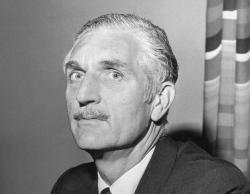
Ludvig Svoboda
 Czech
Czech- State, Political, and Military Leader of Czechoslovakia
- Early Life and Military Career
- Resistance and Exile
- Minister of Defense and Political Involvement
- President and Commander-in-Chief
- Legacy and Honors
State, Political, and Military Leader of Czechoslovakia
Ludvík Svoboda was a prominent figure who held significant positions in Czechoslovakia's political and military spheres. As a general in the Czechoslovak army, he commanded troops during wartime and later became president of the country.
Early Life and Military Career
Born on November 25, 1895, in a farming family, Svoboda pursued an agricultural education. His military journey began in 1915 with his conscription into the Austro-Hungarian army. Sent to the Russian front, he joined a group of Czech patriots and crossed enemy lines in 1916 to join the Czechoslovak Legion.
Returning to his homeland in 1920, Svoboda became a career officer in the Czechoslovak army. He served as an instructor at the Military Academy in Hranice, Moravia, from 1931 to 1934 and later commanded an infantry battalion.
Resistance and Exile
After Nazi Germany occupied Czechoslovakia, Svoboda became an organizer of the anti-fascist military resistance. He fled to Poland in 1939 and formed a Czechoslovak military unit, which he led into the Soviet Union in September 1939.
Svoboda played a pivotal role in the creation of the 1st Czechoslovak Separate Infantry Battalion in Buzuluk, Russia. This unit saw its first combat against the German army in 1943 at Sokolovo. Svoboda subsequently commanded the 1st Czechoslovak Separate Brigade and the 1st Czechoslovak Army Corps, participating in significant battles such as the Dukla Operation and the liberation of Slovakia.
Minister of Defense and Political Involvement
From 1945 to 1950, Svoboda served as Minister of National Defense. He signed the Košice Program alongside other Czechoslovak leaders. In 1948, he joined the Communist Party of Czechoslovakia (CPCz), becoming a member of the National Assembly.
Svoboda held various government positions in the 1950s, including Deputy Prime Minister and Chairman of the State Committee for Physical Education and Sports. From 1955 to 1959, he was the head of the Military Academy named after K. Gottwald.
President and Commander-in-Chief
In March 1968, Svoboda was elected President of Czechoslovakia. He also held the position of Supreme Commander-in-Chief of the Czechoslovak Armed Forces. As President, he remained a member of the CPCz Central Committee and Presidium.
Legacy and Honors
Svoboda received numerous awards, including the Order of K. Gottwald, the Order of Lenin, the Czechoslovak Peace Prize, and the International Lenin Peace Prize. His legacy as a respected military leader and statesman is honored in Czechoslovakia and beyond. Svoboda passed away on September 20, 1979, leaving a lasting mark on his country's history.