Ludwig Yorck
 Germany
- Biography of Ludwig Yorck von Wartenburg
- Early Life and Military Career
- Military Achievements and Reforms
- Russo-Prussian-French War
- Later Life and Contributions
Biography of Ludwig Yorck von Wartenburg
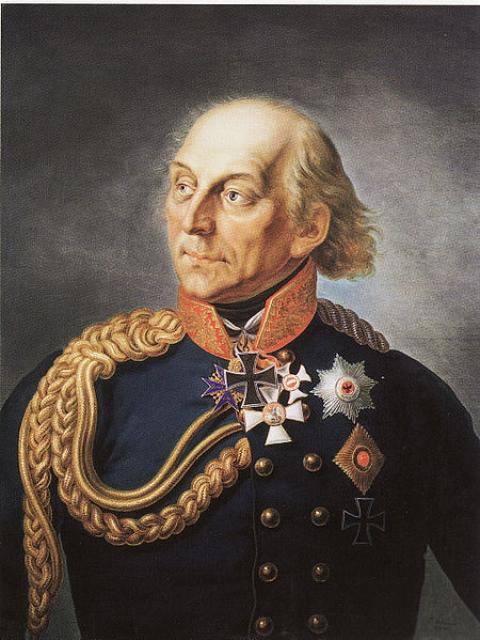
Ludwig Yorck von Wartenburg was a Prussian general and field marshal, as well as the founder of the Yorck von Wartenburg counts. He was born into a family of a Prussian captain, who was originally from the Kashubian region and changed his surname from Jark von Gostkowski to Yorck.
Early Life and Military Career
At the age of 13, Yorck joined the Prussian infantry regiment as a cadet, and in 1777, he was promoted to the rank of second lieutenant. In 1779, he accused his captain, Naurbach, of theft and was subsequently expelled from the service and imprisoned in the fortress of Königsberg for a year. After his release, King Frederick the Great refused to reinstate him, leading Yorck to join the Swiss regiment of the Dutch army as a captain and take part in campaigns in the East Indies from 1783 to 1784. He returned to Prussia in 1785 and applied to be reinstated in the military.
Military Achievements and Reforms
In 1787, Yorck was granted the rank of captain and appointed as the commander of a company by King Frederick William II. He continued to rise through the ranks and became a major in 1792. During the Polish campaign of 1794-1795, Yorck commanded a battalion and distinguished himself in the Battle of Szczekociny. In 1797, he was given command of a Jäger regiment and promoted to colonel in 1805, serving as the commander of a brigade. His successful career reflected his contributions to modernizing the Jäger service and aligning it with the requirements of the time.
Russo-Prussian-French War
During the Russo-Prussian-French War of 1806-1807, Yorck commanded the vanguard of the Duke of Weimar. Upon hearing the news of the defeat at Jena and Auerstedt, he retreated to Gartz, where he joined forces with Blücher. On October 26, he engaged in the Battle of Altenzaun, where he defeated the French and displayed remarkable tactical skill. This victory marked the first triumph over the French since the defeat at Jena. In the final battle of the war, fought on the streets of Lübeck on November 6, Yorck was wounded and captured. He was exchanged for a French general aide-de-camp in June 1807 and was awarded the rank of major general and the Pour le Mérite order for his successful actions during the war.
Later Life and Contributions
After the war, Yorck played an active role in the reform of the Prussian army. He held positions such as the commander of the West Prussian brigade, inspector general of light troops (1810), and governor general of both West Prussia (1811) and East Prussia. In 1812, as a lieutenant general, Yorck replaced General Gravert, who was strongly opposed to the French, as the commander of the Prussian auxiliary corps within Marshal MacDonald's 10th French corps. He took part in the campaign against Russia, acting on the Riga front without much enthusiasm.
During the retreat from Russia, Yorck commanded the rearguard of MacDonald's forces but became separated and surrounded by Russian troops under the command of Diebitsch. Under pressure from his officers and believing it was time to break away from Napoleon, Yorck took the risk and on December 18, he signed the famous Convention of Tauroggen with the Russians, in which his corps agreed to adopt a state of "neutrality". Initially, the king ordered his dismissal and trial for insubordination, but subsequent events prevented the execution of this order. Diebitsch refused to allow the king's messengers through his troops, and after Prussia switched sides, all charges against Yorck were dropped, and his corps became the foundation of the new Prussian army. On March 17, 1813, the day Prussian king declared war on Napoleon and his allies, Yorck triumphantly entered Berlin at the head of his corps.