Manuel Odria
 Peru
Peru- Manuel Odría: Peruvian military and political figure
- Early Life and Military Career
- Political Involvement
- Presidency and Policies
- Later Years and Legacy
Manuel Odría: Peruvian military and political figure
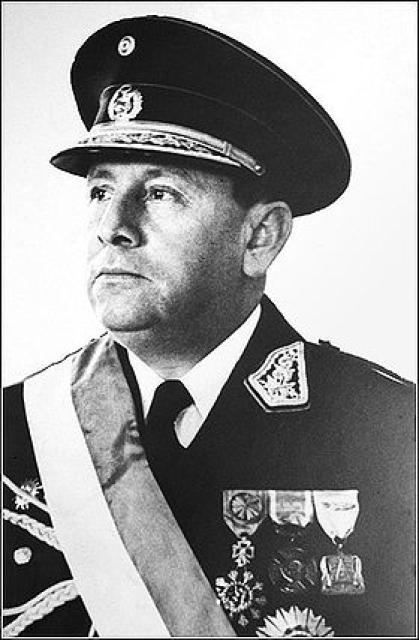
Manuel Odría was a Peruvian military and political figure who served as the President of Peru from October 29, 1948, to May 28, 1950, and from July 28, 1950, to July 28, 1956.
Early Life and Military Career
Manuel Odría was born on November 26, 1897, in the city of Tarma, Peru. In 1915, he graduated from the Military Academy and joined the Peruvian armed forces. He participated in the war with Ecuador as a lieutenant colonel and soon after the war, Odría was promoted to the rank of general.
Political Involvement
In 1945, with the support of the American Popular Revolutionary Alliance (APRA), José Luis Bustamante y Rivero came to power as the President of Peru. However, he soon had a serious conflict with the leader of APRA, Víctor Raúl Haya de la Torre. Bustamante appointed Manuel Odría as the Minister of Police, as Odría was one of the main opponents of the organization.
In October 1948, a group of naval officers and sailors killed senior officers, seized five military ships, and then landed on the shore, capturing the Naval Academy, weapon caches, and the Fortress of King Philip. After loyalist forces suppressed the uprising, José Luis Bustamante significantly curtailed civil rights.
Presidency and Policies
Blaming APRA for organizing the uprising, Bustamante's government troops occupied the headquarters of the organization, seized its assets and newspapers, and arrested several of its leaders. These actions were not enough, as many military personnel remained dissatisfied with the president and demanded a complete ban on APRA. On October 29, 1948, Manuel Odría organized a coup d'état and came to power.
Odría's rule in Peru is compared to the policies of Juan Perón in Argentina. He successfully suppressed the actions of APRA and gained support from the Peruvian oligarchy. Like Perón, he pursued a populist policy to win the favor of the lower classes of Peruvian society, which he achieved through economic success.
However, during his presidency, civil rights were significantly limited. The Peruvian population feared that his regime would last for a long time, and under pressure, Odría organized free elections in which he decided not to run as a candidate. The ex-president Manuel Prado y Ugarteche won the elections.
Later Years and Legacy
One of Odría's main achievements is considered to be the granting of suffrage rights to women, which took place on September 7, 1955. In 1962, he ran for president as a candidate of the National Union of Odriists, a party named after him. However, none of the three main candidates, Odría, Haya de la Torre, and Fernando Belaúnde, secured the necessary one-third of the votes.
After the elections, it was planned that Odría, who formed an alliance with Haya de la Torre, would win in the congressional elections and become the president. However, a few days before the end of his term, a coup d'état occurred against Manuel Prado, which disrupted the plans of Odría and Haya de la Torre. Despite condemnation from the international community and the rupture of diplomatic relations with several countries, Peru was led by the Chairman of the Joint Chiefs of Staff, Ricardo Pérez Godoy.
In 1963, new elections were held, and Fernando Belaúnde won with 36% of the votes. Odría entered into opposition to Belaúnde's government. Manuel Odría passed away on February 18, 1974, in Lima at the age of 77. His remains rest in the mausoleum of the cathedral in his hometown of Tarma.