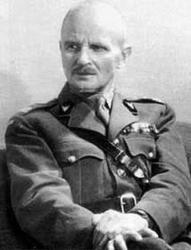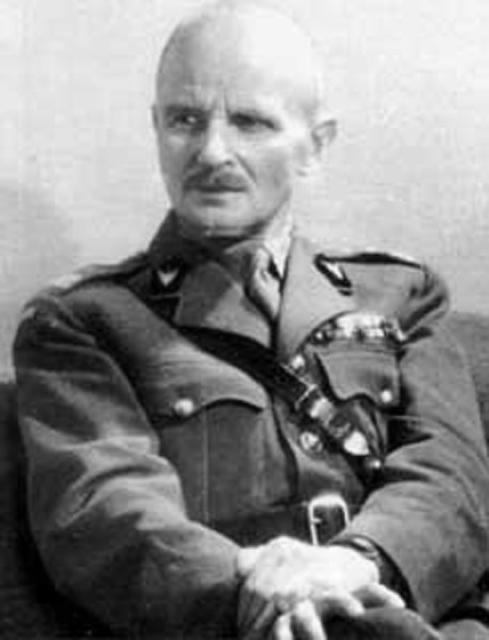
Marian Kukiel
 Great Britain
- Biography of Marian Kukiel
- Early Life and Revolutionary Activities
- Military Career and Political Involvement
- Role in Polish Army and Political Positions
- Later Career and Contributions
- Exile and Post-War Activities
- Legacy and Honors
Biography of Marian Kukiel
Marian Władysław Kukiel was born on May 15, 1885, in Dąbrowa Tarnowska, Galicia. His father, Adolf Józef Kukiel, was a veteran of the 1863-1864 Uprising and a civil servant. His mother, Helena Sroczyńska, was the daughter of a participant in the 1846 Kraków Uprising and a member of the National Committee of Galicia.
Early Life and Revolutionary Activities
In 1903, Marian Kukiel graduated from a classical gymnasium in Tarnów and began studying at the University of Franz Joseph in Lviv. He was involved in revolutionary and liberation activities from his high school years, being a member of the Luminous Organization and the Unforgiven Organization in Lviv. In late 1905, he was arrested and imprisoned in Piotrków Trybunalski.
Military Career and Political Involvement
In 1908, Kukiel co-founded the Union of Active Struggle in Lviv with Mieczysław Dąbkowski, Władysław Sikorski, Kazimierz Sosnowski, and Józef Piłsudski. In 1910, he founded the Union of Marksmen. During World War I, he served in the 1st Brigade of the Polish Legions and the Polish Armed Forces, completing the Military Officers' Course of the General Staff in 1917.
Role in Polish Army and Political Positions
On August 31, 1917, Kukiel became the first commander of the Podhale School in Ostrołęka, where he began his service in the Polish Army. He commanded the 51st Infantry Regiment and later the XXIV Infantry Brigade during the Polish-Bolshevik War. In late September 1920, he took the position of Deputy Chief of the 3rd Department of the Ministry of Military Affairs. In January 1923, he became the Chief of the Military Historical Bureau of the General Staff.
Later Career and Contributions
After leaving the army in September 1926 (1930?), Kukiel pursued an academic career as a professor of military history at Jagiellonian University. In 1930, he became the director of the Czartoryski Museum in Kraków. He was a member of the Warsaw Scientific Society and the Polish Academy of Arts. In August 1939, he volunteered for the army but did not receive a service appointment. He participated in the defense of Lviv and later moved to France in the fall of 1939.
Exile and Post-War Activities
In exile, Kukiel served as the Deputy Minister of Military Affairs under General Sikorski in France. After the evacuation of the Polish Armed Forces to the United Kingdom, he assumed command of the Polish Camps and Departments in Scotland, which were later renamed the 1st Polish Corps on September 28, 1940. On September 24, 1942, he became the Minister of National Defense and held this position until 1949.
Legacy and Honors
On April 16, 1943, Kukiel issued a communiqué to the International Red Cross regarding the Katyn Massacre, which led to a rupture in relations between the Polish government in exile and the Soviet government. After the war, he remained in exile and became one of the founders of the General Sikorski Historical Institute, serving as its director. He also founded the political journal "Vedomosti" in 1946. Kukiel was the Chairman of the Board of the Polish Institute and Sikorski Museum from 1965 and the President of the Polish Historical Society in 1970. He passed away on August 15, 1973, in Mabledon Hospital and was buried in Kensal Green Cemetery in London.
Throughout his career, Kukiel received various military honors and awards, including the Silver Cross of the Order of Virtuti Militari, the Commander's Cross of the Order of Polonia Restituta, the Cross of Valor four times, and the Golden Cross of Merit with Swords.