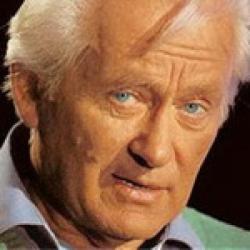
Martinus Veltman
 Netherlands
- Childhood and Education
- Research at CERN and SLAC
- Career in Utrecht and the United States
- Scientific Collaborations
- Nobel Prize and Legacy
Childhood and Education
Martinus J.G. Veltman was born in Waalwijk, Netherlands, on June 27, 1931, the fourth of six children to a primary school headmaster. He attended school in his hometown and went on to study physics at Utrecht University in 1948. In 1953, he completed his pre-diploma with an average grade. He received his diploma in 1956 and served three years of military service before pursuing a PhD in theoretical physics under Leon van Hove.
Research at CERN and SLAC
In 1961, Veltman moved to Geneva when his supervisor became director of the Theoretical Studies Division at CERN. He completed his PhD in 1963 and spent several months observing neutrino experiments at CERN before moving to the SLAC laboratory at Stanford University. However, he returned to CERN after a few months.
Career in Utrecht and the United States
In 1968, Veltman assumed a professorship at Utrecht University, replacing his former supervisor who had retired. He spent a year at the University of Michigan before deciding to move to the United States, where he settled in Ann Arbor in the fall of 1981. Veltman retired in 1996 and lived in Bilthoven, Netherlands, until his death in 2021.
Scientific Collaborations
Veltman collaborated extensively with his student, Gerard 't Hooft, on the mathematical formulation of gauge theories and renormalization theory. In 1977, he predicted the mass of the top quark, which was a crucial step in its eventual discovery in 1995.
Nobel Prize and Legacy
In 1999, Veltman and 't Hooft were awarded the Nobel Prize in Physics "for elucidating the quantum structure of electroweak interactions." Veltman's work has had a profound impact on particle physics and continues to inspire researchers worldwide.