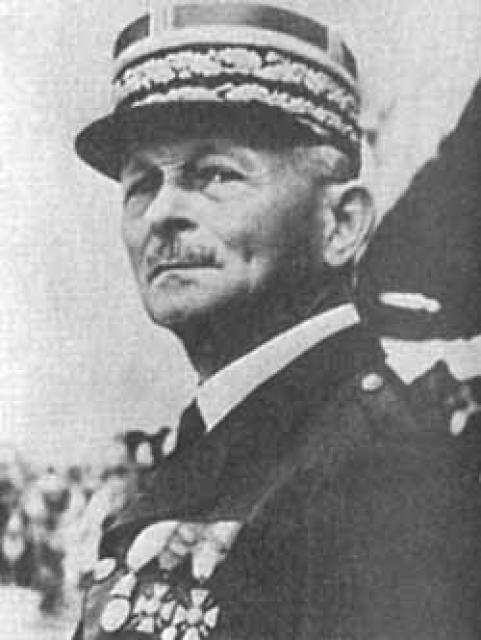
Maxim Weygand
 France
- Biography of Maxime Weygand
- Participation in World War I
- Activities in Poland and Syria
- Role in the French Military and Politics
- Involvement in Fascist Movements
- Role in World War II and Controversies
- Arrest and Rehabilitation
Biography of Maxime Weygand
Maxime Weygand was a French general who played a significant role in French military and political affairs during the early 20th century. Born on January 21, 1867, he began his military career by attending the military school in Saint-Cyr.
Participation in World War I
Weygand became a participant in the First World War and served as the commander of a cavalry regiment. In March 1917, he became a member of the Supreme War Council, and in March 1918, he was appointed as the Chief of Staff to the Supreme Commander, representing France in the Military Council of the Allies in Versailles.
Activities in Poland and Syria
After the war, Weygand continued his military service and held various positions of importance. From 1920 to 1922, he served as the head of the French military mission in Poland, overseeing the training and equipping of the Polish army. In 1923, he became the High Commissioner of the French Republic in Syria and the Commander-in-Chief in the Levant.
Role in the French Military and Politics
In 1930, Weygand was appointed as the Chief of the General Staff and Vice President of the Supreme Military Council. However, he was later removed from his position in 1931 and was appointed as the Inspector General of the Army and Vice President of the Supreme Military Council. He retired from active service in 1935.
Involvement in Fascist Movements
In 1937, Weygand, along with Alexandre Petain, became one of the organizers of the fascist movement known as "kagoulards." This involvement would later tarnish his reputation.
Role in World War II and Controversies
As the German forces invaded France in 1940, Weygand replaced Maurice Gamelin as the Chief of Staff of National Defense and the Supreme Commander of the French Armed Forces. He attempted to organize a defense line known as the Weygand Line but faced numerous defeats, which led him to realize the futility of resistance. Weygand supported Petain's policy of capitulation to Germany.
After the fall of France, Weygand served as the Minister of National Defense in the Vichy government from July 16, 1940. However, in November 1941, he was relieved from his duties and sent to Algeria as the General Governor and Commander-in-Chief.
Arrest and Rehabilitation
Weygand attempted to resist German influence while in Algeria but was eventually arrested by the Gestapo in November 1942. He was imprisoned in a concentration camp but was later freed by the Allies. Despite his release, he faced further challenges in France, as he was arrested by French authorities in May 1945 for alleged collaboration with the Germans.
However, in March 1946, Weygand was released due to health reasons, and in May 1948, the Supreme Court dropped all charges against him. Maxime Weygand passed away on January 28, 1965, leaving a complex legacy as a prominent military figure in French history.


