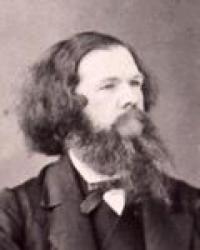
Michael Veske
 Estonia
Biography of Mikhail Veske
Mikhail Petrovich Veske (1843 - May 4, 1890) was a remarkable researcher in the field of Finnish languages. He was born in 1843 in the family of an Estonian peasant in the Veske estate in the Livonian Governorate. Initially, Veske attended a local village school and intended to become a rural teacher. However, his desire to become a missionary and travel to East India led him to enroll in the Leipzig Mission House in 1866. The theological sciences were unable to satisfy the young Estonian, who sought practical activities. He decided to dedicate himself to serving his native people, studying their language and customs, and awakening their national consciousness.
Education and Research
In 1867, Veske enrolled at Leipzig University, where he focused on Indo-European linguistics. He later successfully began researching Finnish languages. In 1872, he earned a Ph.D. in philosophy for his dissertation "Untersuchungen zur vergleichenden Grammatik des finnischen Sprachstammes" (Leipzig). Throughout this time, Veske received a subsidy from Grand Duchess Elena Pavlovna, who appointed him an annual allowance of 200 talers based on the request of the Russian Consul General in Leipzig, Tave. In 1873, after the death of Grand Duchess Elena Pavlovna, Veske was forced to return to his homeland.
Career and Contributions
Initially, Veske made a living through private lessons when he arrived in Tartu. However, in September 1874, he was elected as a lecturer of the Estonian language at the University of Tartu. From that time onwards, he undertook scientific trips to Estonian parishes almost every summer, and in the summer of 1880, he traveled to Finland. During his journeys, Veske collected folk songs (totaling more than 1500), materials for determining dialectical differences, and studying mythology.
Veske's linguistic research had not only theoretical goals but also practical applications. As a scientist, poet, and journalist, Veske drew inspiration from folk dialects to develop literary Estonian language. His scientific activities went hand in hand with his involvement in society. Veske emerged as a passionate advocate for the national revival of the Estonian people, opposing the Germanization of his nation. His preferences and antipathies were strongly demonstrated during the revision of the region conducted by Senator Manasein.
In 1885, on the recommendation of the University of Tartu, Veske was sent by the government to Hungary for two years, and from there to the Volga and the Urals to study Hungarian and East Finnic languages. In 1887, he was appointed as a lecturer of Finnish dialects at Kazan University, which had invited him to join an expedition to the Chuvash people in 1882. In 1889, Veske embarked on a trip to study the Mordvin people. The result of his two journeys to the local indigenous people, the Chuvash and Mordvin, were the works "Исследования о наречиях черемисского языка" (Kazan, 1889) and a collection of 200 Chuvash and Mordvin songs.
In Kazan, Veske began his most important work, "Славяно-финские культурные отношения по данным языка" (Vol. I, Kazan, 1890). In this work, he decisively and definitively expressed the idea of the wide prehistoric influence of Slavic culture on the Finnish world. Unfortunately, Veske's unexpected death on May 4, 1890, prevented him from completing the second volume of this work. Veske served as the editor of the scientific and belletristic journal "Ота Маа" ("Native Land"), published in Estonian since 1884. His individual articles on Estonian mythology and the Estonian language were published in editions of Estonian scientific and literary societies.