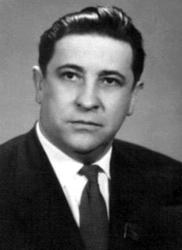
Mihail Iovchuk
- Early Life and Education
- Political and Administrative Roles
- Academic Career
- Member of the Soviet Elite
- Controversies and Legacy
Early Life and Education
Mikhail Tikhonovich Yovchuk was a prominent Soviet philosopher and party official. Born into a peasant family, Yovchuk's interest in philosophy emerged during his studies at the Academy of Communist Education named after N.K. Krupskaya, which he graduated from in 1931. Following his graduation, he pursued a postgraduate degree at the Communist University of Lecturers in Social Sciences.
Political and Administrative Roles
Yovchuk joined the Communist Party in 1926. From 1933 to 1936, he served as the head of the political department of a state farm in the Belorussian SSR. Subsequently, he held leadership positions in the Moscow Institute of Chemical Technology and the Moscow Agricultural Academy. In 1939, Yovchuk became involved in party work at the Executive Committee of the Comintern. From 1941 to 1947, he worked in the Propaganda and Agitation Department of the Central Committee of the Communist Party of the Soviet Union (CPSU), eventually becoming the deputy head of the department in 1944.
Academic Career
Yovchuk's academic career spanned over four decades. He received his Candidate of Philosophical Sciences degree in 1936 for his dissertation on the philosophical and socio-political views of Vissarion Belinsky. In 1946, he obtained his Doctor of Philosophical Sciences degree from the Academy of Social Sciences of the CPSU, where he defended his dissertation on the history of Russian materialist philosophy of the 18th and 19th centuries. In 1943, Yovchuk established and led the Department of History of Russian Philosophy at Moscow State University.
Member of the Soviet Elite
In 1946, Yovchuk became a Corresponding Member of the Academy of Sciences of the USSR. He served as the Secretary of Propaganda and Agitation for the Central Committee of the Communist Party of Belarus from 1947 to 1949. From 1949 to 1970, he held various academic positions at the Ural University, Moscow State University, and the Institute of Philosophy of the USSR Academy of Sciences.
Controversies and Legacy
In 1955, Yovchuk was involved in a sexual scandal known as the "Gladiators' Affair." Despite this, he continued to advance in his political and academic careers. From 1970 to 1977, he served as the Rector of the Academy of Social Sciences of the CPSU. In 1971, he became the inaugural recipient of the G.V. Plekhanov Prize of the USSR Academy of Sciences for his works on Plekhanov and Leninism.
Yovchuk is recognized as one of the founders of the Sverdlovsk Philosophical School. He received numerous awards for his contributions, including the Order of Lenin, the Order of the October Revolution, and the Order of the Red Banner of Labor. Yovchuk's legacy continues to be debated among historians and philosophers, with some praising his scholarship while others criticize his involvement in Soviet propaganda.