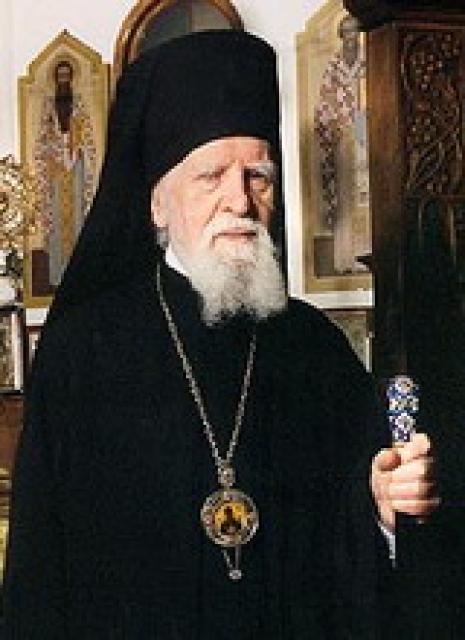
Mitrofan Znosko-Borovskiy
 Russia
- Early Life and Family
- Education and Early Ministry
- Ordination and Service in Poland
- World War II and Refugee Life
- Ministry in Morocco and North Africa
- Ministry in the United States
- Teaching and Theological Contributions
- Monasticism and Consecration as Bishop
- Later Years
Early Life and Family
Metropolitan Mitrofan Znosko was born in Brest-Litovsk, Russian Empire (now Belarus), on June 12, 1908. His father, Konstantin, was a priest who served in the Holy Trinity Cathedral in Brest-Litovsk and later as chaplain in the Russian army during World War I. Mitrofan had sixteen siblings, but seven died in infancy. His elder brother, Arseny, became a priest in the USSR and died in 1925. His younger brother, Alexei, served as a priest in the Polish Orthodox Church and became a protopriest and Doctor of Theology.
Education and Early Ministry
Mitrofan graduated from a Russian gymnasium in Brest and studied at the theological faculty of the University of Warsaw. However, he confronted a professor who supported Ukrainian nationalism in Orthodoxy and transferred to the theological faculty of the University of Belgrade, graduating in 1934. During this time, he befriended the future bishop and archbishop, John (Maximovich). He also earned a Master's degree in theology from the University of Warsaw.
Ordination and Service in Poland
In September 1935, Mitrofan was ordained a deacon, and on June 25, 1936, a priest. He served as a religious instructor at a Russian gymnasium in Brest and was rector of the Assumption Church in the village of Omelenets in Belarus. From 1938 to 1944, he was rector of the Holy Trinity Cathedral in Brest, where his father had previously served. He became a protopriest in June 1941 and the dean of the Brest district and chairman of the diocesan administration of the Brest diocese.
World War II and Refugee Life
During World War II, Mitrofan assisted those persecuted by the German occupation authorities, including Jews. He lived in Germany and Austria from 1944 to 1948, under the jurisdiction of the Russian Orthodox Church Outside Russia (ROCOR). He served in a church in a displaced persons camp in Menchehof and was a religious instructor at the Lomonosov Gymnasium in the same camp. From 1946, he was a member of the diocesan council of the German diocese.
Ministry in Morocco and North Africa
From 1948 to 1959, Mitrofan served as rector of the Assumption Parish in Casablanca, Morocco. He established the Saint Sergius Charity Fund, which supported Russian refugees. From 1950, he was the dean of the Moroccan district, and from 1954, he administered Russian Orthodox communities in North Africa.
Ministry in the United States
In 1959, Mitrofan moved to the Holy Trinity Church in Sea Cliff, New York, where he remained as rector until his death. He faced conflicts with high-ranking members of ROCOR, including Protopriest Georgy Grabbe (later Bishop Gregory).
Teaching and Theological Contributions
From 1967 to 1975, Mitrofan taught apologetics and comparative theology at Holy Trinity Theological Seminary in Jordanville, New York. He also taught pastoral theology from 1974 to 1975 and served as vice-rector for a time. His lectures on comparative theology were republished in Russia in the 1990s and used as textbooks in a Russian theological seminary.
Monasticism and Consecration as Bishop
After the death of his wife, Mitrofan was tonsured as a monk, retaining the name Mitrofan. On November 24, 1992, he was consecrated as the Bishop of Boston, Vicar of the Eastern American Diocese of ROCOR.
Later Years
Mitrofan continued to celebrate liturgies and participate actively in church life until his death at the age of 94 on July 14, 2002.