Mustafa III
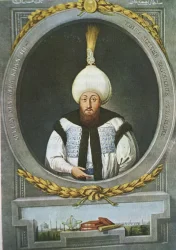
Mustafa III was sultan of the Ottoman Empire from 1757 until 1774. His reign began during a period of relative peace and ended amid a costly war with Russia that exposed the empire’s military and financial weaknesses. He recognized the need for reform and supported efforts to modernize parts of the army, while also commissioning major building projects in Istanbul.
Accession and early rule
Mustafa was born in Istanbul on 28 January 1717, the son of Sultan Ahmed III. He spent many years in the palace before succeeding his cousin Osman III in October 1757. His accession followed decades in which Ottoman princes were often kept away from public political life, leaving the new sultan with limited experience of government.
In the early years of his reign, much of the administration was led by the capable grand vizier Koca Ragıp Pasha. The government sought to preserve peace and address financial pressures. Mustafa took a close interest in affairs of state and supported limited military and administrative reforms, including artillery training and efforts to strengthen the navy.
War with Russia
The major event of Mustafa’s reign was the Russo-Turkish War of 1768–1774. Tensions with Russia over influence in Poland and the Black Sea region escalated into open conflict. Ottoman forces suffered a series of defeats, while the Russian fleet entered the Mediterranean and destroyed much of the Ottoman fleet at the Battle of Çeşme in 1770.
The war placed severe strain on the imperial treasury and military. Mustafa supported attempts to improve the armed forces, including the establishment of an artillery school and new formations, but these measures were not sufficient to reverse the course of the conflict. The empire’s military setbacks continued after his death, and the Treaty of Küçük Kaynarca was signed in 1774 under his successor, Abdülhamid I.
Architecture and legacy
Mustafa’s reign also left a visible mark on Istanbul’s architecture. He commissioned the Laleli Mosque complex, completed in the 1760s, as well as the Ayazma Mosque in Üsküdar. Earthquakes in 1766 and 1767 damaged parts of the capital, prompting extensive reconstruction.
Mustafa died in Istanbul on 21 January 1774 and was succeeded by his brother Abdülhamid I. His legacy reflects both a reform-minded ruler’s awareness of the empire’s challenges and the limits imposed by entrenched institutions, financial constraints and a disastrous war.