Mykolas Burokevicius
 Lithuania
- Early Life and Career
- Academic and Political Rise
- Leadership of the Lithuanian Communist Party
- January Events of 1991
- Arrest, Trial, and Imprisonment
- Release and Aftermath
Early Life and Career
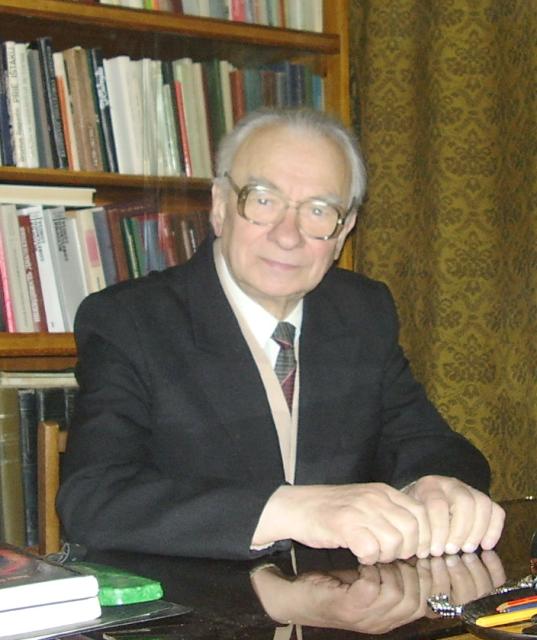
Mykolas Burokevičius was a prominent figure in Soviet Lithuania's history. Born into a working-class family, he initially worked as a carpenter and machinist in Udmurtia after the outbreak of World War II.
In 1944, Burokevičius joined the Komsomol and later the Communist Party in Lithuania. He held various positions within the organization, including instructor, head of the party office in Vilkaviškis, and head of a department within the Vilnius City Committee of the Communist Party of Lithuania.
Academic and Political Rise
In 1963, Burokevičius became a senior research fellow at the Institute of Party History and later chaired the department at Vilnius Civil Engineering Institute. He graduated from Vilnius State Pedagogical Institute in 1955 and the Academy of Social Sciences in 1963. In 1975, he defended his doctoral dissertation on the ideological work of the Communist Party of Lithuania among the intelligentsia.
From 1976 onward, Burokevičius became a professor at the Department of Scientific Communism at Vilnius State Pedagogical Institute.
Leadership of the Lithuanian Communist Party
After the split within the Communist Party of Lithuania in December 1989, Burokevičius became secretary and, from March 4, 1990, First Secretary of the Central Committee of the Communist Party of Lithuania (CPL) aligned with the Communist Party of the Soviet Union (CPSU). At the 28th Congress of the CPSU in July 1990, he was elected to the Central Committee and later to the Politburo.
January Events of 1991
In early January 1991, Burokevičius requested that Mikhail Gorbachev send troops to Vilnius. Gorbachev refused, but troops were deployed at the behest of Soviet Interior Minister Boris Pugo and Defense Minister Dmitry Yazov. The resulting events of January 11-13, 1991, saw the declaration of a "Committee of National Salvation for Lithuania" as the sole legitimate authority in the republic, the attempted seizure of the Supreme Council and television center, the deaths of 14 people, and the wounding of 144.
Arrest, Trial, and Imprisonment
On January 13, 1991, Lithuanian prosecutors initiated criminal proceedings against Burokevičius for his alleged role in an attempted coup d'état. However, he was not arrested and fled to Belarus after the collapse of the Soviet Union.
On January 15, 1994, Burokevičius was apprehended in Minsk and extradited to Lithuania. In October 1996, his trial began in the Vilnius District Court in connection with the "January 13, 1991, Coup d'État." He was charged with conspiracy to overthrow the government, organizing military actions, and complicity in murder and assault.
Burokevičius defended himself by alleging that his actions were influenced by provocateurs and American specialists in urban warfare. In August 1999, he was found guilty and sentenced to 12 years in prison.
While incarcerated, Burokevičius underwent heart bypass surgery. In 2000, Lithuanian President Valdas Adamkus offered to pardon him if he appealed, but Burokevičius declined.
Release and Aftermath
Burokevičius was released on January 13, 2006. He spent approximately seven years in prison before being transferred to a strict regime colony.
In 2006, Burokevičius and two other individuals filed a complaint with the European Court of Human Rights (ECHR), which ultimately ruled in 2008 that they had been properly convicted for their actions under Lithuanian law.
Burokevičius maintained his innocence and died in Lithuania on September 17, 2022, at the age of 94. His legacy remains controversial, with some viewing him as a symbol of Soviet oppression, while others see him as a victim of political persecution.