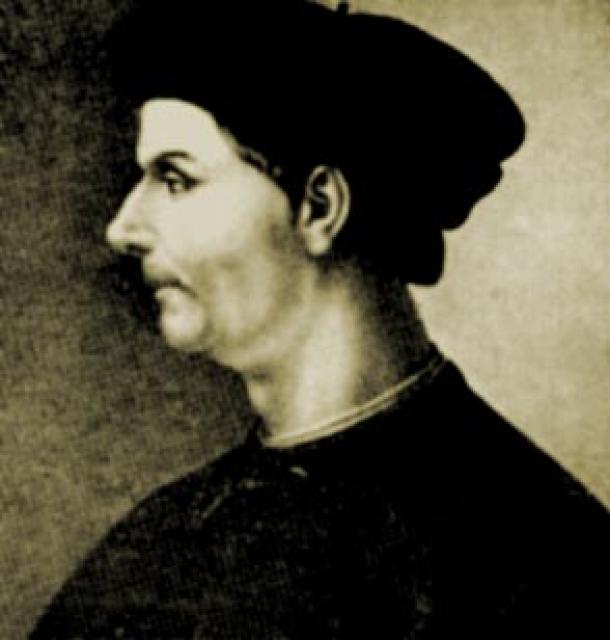
Nikkolo Machiavelli
 Italy
ItalyBiography of Niccolo Machiavelli
Niccolo Machiavelli, an Italian political thinker, historian, writer, and advocate of strong centralized government, was born on May 3, 1469, into a family of lawyers. His father, Bernardo Machiavelli, also earned a small income from his land holdings. His mother, Donna Bartolomea, was a religious woman who composed hymns and songs in honor of the Virgin Mary and sang in the choir at the Church of Santa Trinita.
At the age of seven, Niccolo enrolled in the school of Master Matteo, and later in the city school. By the end of his education, he had gained a strong command of Latin and had completed a course in Latin stylistics. However, due to the modest means of his family, Niccolo was unable to attend university.
Niccolo's teachers included ancient authors such as Livy, Tacitus, Cicero, Caesar, Virgil, Suetonius, Ovid, Tibullus, and Catullus. It is likely that his father introduced him to the basics of legal science and practice. On February 18, 1498, Machiavelli ran for the position of secretary in the second chancellery of the republic and was defeated by a candidate from the party of the Dominican monk Savonarola. However, in April, Savonarola's party collapsed, and the Dominican himself was executed on May 23...
Five days after these events, Machiavelli, having defeated the candidate from the Medici party, was appointed and on June 18 confirmed as the secretary of the second chancellery. On July 14, he was also entrusted with the chancellery of the Ten, responsible for foreign and military affairs. Very soon, the Florentine Signoria realized that they had made the right choice. The 29-year-old Niccolo Machiavelli successfully carried out his duties. Over the course of fourteen years, he compiled thousands of diplomatic letters, reports, government orders, military orders, draft laws, and made thirteen diplomatic and military-diplomatic trips with complex missions to various Italian states and governments, the Pope, Emperor, and the French king. As the secretary of the Ten, he was the organizer and participant in military campaigns and the initiator of the creation of the republican militia.
In March 1499, Machiavelli went to Pontedera to meet with the ruler of Piombino, located a hundred kilometers southwest of Florence. The 30-year-old secretary of the Ten convinced d'Appiano, this crowned military leader, not to demand an increase in payment for military service to the Florentine Republic, which was already spending colossal amounts on condottieri mercenaries. In July of the same year, Machiavelli was sent to the ruler of the strategically important city of Forli, Catherine, the daughter of Galeazzo Sforza, with an official letter from Florence's first chancellor, Marcello Virgilio Adriani, a student of Poliziano, a university professor of literature. Despite all the cunning and experience of the cunning ruler, the Florentine envoy successfully maintained friendship with the ruler of Forli, which was extremely important in the tense struggle for the important trading center of Pisa.
Meanwhile, the clouds over Italy were darkening. In October 1499, French troops entered Milan, and at the beginning of the next year, its ruler Ludovico Sforza was captured and taken to France. The fate of the Italian states now depended on Louis XII, to whom the Florentine Republic sent a diplomatic delegation in July 1500, comprised of Niccolo Machiavelli and Francesco Casas. Previously, the question of Pisa was decided by Florence, but now it was being decided by the French court, which demanded enormous sums of money for military assistance. Machiavelli was not one of the ceremonial ambassadors sent on solemn occasions, but rather a diplomat-orator who, in his own words, "prepares the way for the Lord" and achieves everything solely by his talents and intellect. The great Florentine not only carried out official instructions but also closely observed and evaluated the situation, the people, and the customs. Machiavelli visited Lyon, Nevers, Mele, and Paris. His reports to the Florentine Signoria were no less important than conducting negotiations. "The French are blinded by their own power," Machiavelli and Casas wrote, "and only consider those who possess weapons or are willing to give money." Soon, their advice made the French court take the politics of the papacy more seriously.
During this same mission to France, he showed himself to be a subtle psychologist. In his reports to the Florentine Signoria, he described Giulio de Scruziatio, a defector from the Aragonese camp, who was present at the French court: "At the first opportunity, he will play the role of a lightning bolt... he is eloquent, extremely brave, intrusive, terrifying, does not know the limits of his passions, and therefore can achieve some result in all his endeavors."
Upon his return from France in 1501, Machiavelli dealt with matters related to the subordinate but perpetually rebellious city of Pistoia. He corresponded, wrote orders, and traveled three times to the rebellious region to resolve the conflict. In the same year, he carried out a number of assignments in Siena and Casoni.
In 1502, Machiavelli met Cesare Borgia, the Duke of Valentinois, who made a strong impression on him - cruel, cunning, disregarding any moral norms, but a bold, decisive, and perceptive ruler. He did not idolize Cesare Borgia but studied his actions when he tried to subdue and unite entire regions of Italy. Machiavelli met this hero of the sword and poisoned wine several more times and noted the qualities of this statesman worthy of theoretical generalizations in his reports.
Together with Bishop of Volterra Francesco Soderini, Machiavelli arrived in Urbino, which had been captured by Cesare Borgia. Soderini and Machiavelli were received at two in the morning on June 24, 1502. Their joint impression was presented in a report: "The Duke is so fearless that even the greatest task seems easy to him. Striving for glory and new possessions, he does not give himself rest, knows no fatigue, and does not recognize danger. He arrives at one place before you can hear about his departure from another. He uses the disposition of his soldiers and managed to gather the best people in Italy around him. Moreover, he is always lucky. All this together makes the Duke victorious and terrifying." This portrait of the military leader and politician can be considered the first draft of the famous treatise "The Prince," which Machiavelli completed in 1513.
In September 1502, Machiavelli was in the army of Cesare Borgia, which occupied Perugia, Assisi, and Sienese castles. He was then urgently sent to Rome in connection with the death of Alexander VI and the election of the new Pope Julius II.
In 1504, he went to France again, to Lyon, with new instructions for Florence's ambassador to Louis XII, Niccolo Valori, who spoke highly of Machiavelli's assistance and advice in his letters to the Ten.
The following year, he was sent with diplomatic missions to Signore Balioni of Perugia, the Marquis of Mantua, and Signore Pandolfo Petrucci of Siena. A year later, he represented the republic to Julius II, who led his troops against Perugia and Bologna. The Florentine ambassador had to diplomatically inform the warlike Pope that Florence, although it was his ally, could not currently provide assistance in his "holy cause."
In December 1507, Machiavelli was sent to Tyrol to Emperor Maximilian with new instructions for the Florentine ambassador. The result of his acquaintance with the situation in German lands was a report on "Events in Germany."
In 1509, he was sent to Mantua to pay the monetary contribution of the republic to King Maximilian, and then to Verona, where he observed the progress of military operations between Venice and Florence's allies.
The following year, Machiavelli embarked on his third diplomatic mission to France for negotiations on joint action against the Venetian Republic. After this trip, he wrote his "Descriptions of Events in France." A few months later, he was sent to France again through Milan to discuss the issue of the Pisan church council, which was organized by Louis XII against Pope Julius II. This council opened in November 1511, and Machiavelli was sent there by the republic to observe the developments.
While carrying out numerous and complex duties, Machiavelli did not become a dull bureaucrat. He had a lively, sociable character, loved dressing well, and spared no expense, even when money was scarce. He particularly cared about his attire when representing the republic to foreign rulers. He was witty and loved to have fun, always being the life of the party at the gatherings organized by the members of the Ten Commission.
Machiavelli married Marietta Corsini when he was thirty-three years old and became a father at the age of thirty-four. He took great care of his family, jokingly calling them his "team."
Machiavelli achieved much as the secretary of the military commission of the Ten, demonstrating himself not only as an executor but also as an organizer in this field.
In 1512, dramatic events occurred that led to the downfall of the Florentine Republic and halted Machiavelli's active political career. On April 11, Spanish troops captured Prato, committing a merciless massacre and looting. Piero Soderini fled from Florence, where the Medici rule was restored, and as a result of the coup, Machiavelli lost his position and was exiled from the city for a year.
The following year, an anti-Medici conspiracy led by Boscoli was uncovered. Suspected of complicity, Machiavelli was thrown into prison in March 1513, subjected to torture with six lashings. He was released from imprisonment only through an amnesty declared following the election of Giovanni Medici, who took the name Leo X, to the papal throne. As an unreliable exile, Machiavelli was allowed to live in his small estate, Sant'Andrea in Percussina, located near Florence.
Machiavelli was doomed to forced inaction. He corresponded with his friends, Soderini and Vettori, and wrote: "This cannot go on for long," he wrote. "Such an inactive life undermines my existence." However, he was willing to serve only his own state, not anyone and anywhere. This is evidenced by his refusal to become the secretary of Cardinal Prospero Colonna in 1521, which he explained by his rejection of the papacy and church officials. He also refused to serve the French monarchy, stating at the end of his life, "I prefer to die of hunger in Florence than of indigestion in Fontainebleau."
Unfortunately, the Medici family did not trust Machiavelli and did not allow him to engage in political activities for fifteen years.
Machiavelli turned to writing. During his exile (1513-1520), he wrote "The Prince," "Discourses on the First Decade of Titus Livius," "Discourses on the Ways of Ordering Affairs in Florence After the Death of Duke Lorenzo," "Description of Events in the City of Lucca," and began "The History of Florence"...
He did not refuse minor business assignments, such as trips to the Franciscan monastery in Carpi, which he called the "republic of wooden sandals" in a letter to Guicciardini, or to Venice to protect the interests of Florentine merchants.
On May 4, 1527, Rome was captured by German landsknechts. Florence responded with an anti-Medici rebellion and the restoration of the republic.
The 58-year-old Machiavelli put forward his candidacy for the position of chancellor of the Florentine Republic. The question was decided at the Great Council of the republic on May 10, 1527. However, the years of Medici rule had taken their toll: only 12 votes were cast for Machiavelli, while 555 were cast against.
On June 21, 1527, Niccolo Machiavelli passed away, and a day later, he was buried in the Church of San Croce, which had become the Florentine pantheon. He rests alongside Michelangelo, Galileo, and other great Italians.