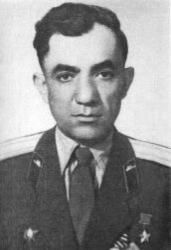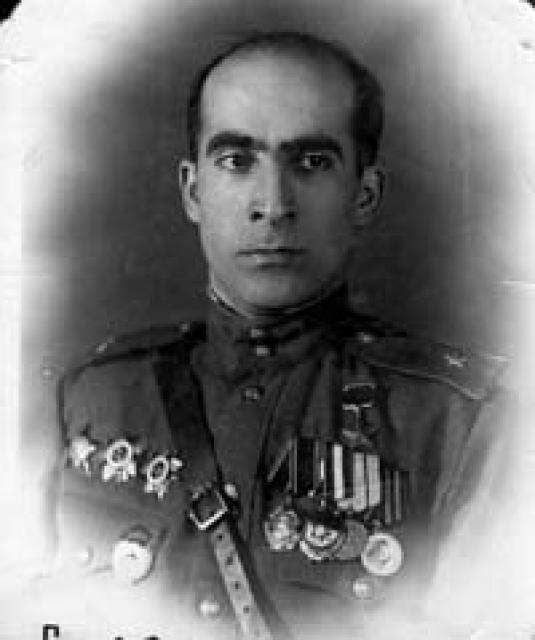
Nikolay Amelko
 Belarus
Biography of Nikolay Amelko
Nikolay Amelko was a Soviet naval commander, admiral, and candidate of naval sciences. He was born on November 22, 1914, in Petrograd. His father, Nikolay Lukich Amelko (1880-1957), was a Belarusian worker. His mother, Tatyana Kalinovna Amelko (1882-1917), passed away when Nikolay was only 2 years old. His caring stepmother, Anna Mikhailovna Amelko, became his true mother figure.
Nikolay was happily married to Tatiana Nikolaevna Amelko (1917-1990) for 51 years. They had a son, Sergey Nikolaevich Amelko (born in 1945), who served in the navy and the Ministry of Defense and is currently a member of the Russian Army. They also had a daughter, Kseniya Nikolaevna Amelko (born in 1952), who is the chief architect of the "Giprozdorav" organization. Nikolay had two granddaughters as well.
The Amelko family lived on the 2nd line of Vasilievsky Island. They lived in poverty, but Nikolay learned to overcome difficulties from a young age. His happiest memories were of his time in the Pioneer detachment, where he participated enthusiastically in various circles, the "Salute" live newspaper, and plays. With his lively "live newspaper," they performed at factories, military units, and especially on visits to the naval border patrol ships based on Golodoy Island and in Kronstadt. It was during these visits that Nikolay developed a passion for maritime romance and decided to become a sailor.
However, he first studied at an FZO school, started working at the age of 14, and then entered the Mikhail Frunze Naval School at the age of 16. As a cadet, he practiced on the training ship "Ucheba," training ships, and the cruiser "Aurora." After graduating from the naval school in 1936, he and six other graduates, including Nikolay Amelko, were sent to Moscow to the Intelligence Department of the Red Army. The widespread repressions in the country also affected ordinary military personnel. Nikolay Amelko was falsely accused by representatives of the "organs" but was soon acquitted. In 1937, he served as the commander of the electronic navigation group of the combat navigational unit of the training ship "Leningradsovet." He was happy to engage in his favorite job, especially since the ship was equipped with the latest navigation devices.
When the war with Finland began, Nikolay Amelko was appointed to command landing ships for the assault on Seskar Island, while still remaining in his post on the "Leningradsovet." After successfully completing the mission, he returned to his ship and soon became the senior assistant commander and then the commander. He sailed with cadets on board the "Leningradsovet" in the Baltic and Northern seas.
With the start of the Great Patriotic War, Nikolay Amelko ensured that the ship was urgently armed with anti-aircraft guns and machine guns, which proved to be effective in repelling air attacks from fascist aviation while based in Tallinn. Twenty sailors and petty officers from the ship joined the naval infantry to reinforce the troops defending the city.
The "Leningradsovet" participated in the famous transfer of the Baltic Fleet from Tallinn to Kronstadt. The crew engaged in intense fire against enemy aircraft. Several sailors and the commander himself were wounded but did not leave their combat positions. Approximately 400 people were rescued from the water from the sunken ships. For his bravery and skilful leadership of the personnel, Nikolay Amelko received his first award, the Order of the Red Banner, and was promoted to the rank of Captain-Lieutenant.
Together with other ships, the "Leningradsovet" was sent to the besieged city to strengthen its air defense and provide artillery support to our troops. Despite limited food and other difficulties in the blockaded city, all the crew members actively participated, even going on reconnaissance missions. In January 1942, Captain-Lieutenant Amelko was appointed commander of the division of net-laying ships and later the commander of the division of smoke-laying boats converted from trawlers. These boats were essential for the fleet, given the frequent bombings and shelling of our ships by the enemy.
One of the most challenging tasks was the landing on Peysari Island, where the boats engaged in a real naval battle with German ships and self-propelled landing barges armed with powerful artillery. Interestingly, during the winter, some sailors from the boats switched to aerosleds, from which they created smokescreens to cover the movement of our troops. They successfully facilitated the transfer of the 2nd Strike Army of General I.I. Fedyuninsky from Lisy Nos to Oranienbaum to break the blockade of Leningrad.
For his combat merits in difficult conditions, the division of smoke-laying boats was awarded the Order of the Red Banner, and its commander, Captain-Lieutenant Amelko, received the Nakhimov Fleet Order of the 2nd degree.
Nikolay Amelko's career continued to progress. In early 1945, he was appointed the chief of staff of the mine-laying brigade of the Kronstadt Naval Defense District, which included 12 divisions (157 ships and boats). His responsibilities increased significantly. As the war was nearing its end, it was necessary to clear the fairways, approaches to ports, and ensure safe navigation. The number of mines of various types exceeded several hundred thousand, making the mine-clearing operations in the Baltic Sea continue until 1953. Fearless sailors destroyed up to a thousand mines daily. Special difficulties arose in finding magnetically and electrically controlled mines, which could only be detonated by ships passing over them multiple times. Scientific forces were involved in this challenging battle. Academician A.P. Alexandrov worked in the Baltic Sea, and Academician I.V. Kurchatov worked in the Black Sea. They developed original and effective methods of mine countermeasures, including demagnetizing ships and vessels. Nikolay Amelko was responsible for implementing these new methods in his unit.
Later, Amelko led (1949-1952) a brigade of ships in the Water Area Guard of the Riga Naval Base, which consisted of several divisions of minesweepers, patrol boats, anti-submarine ships, and boats. They were based in the mouths of the Daugava River, 15 km from Riga. Once again, they faced the arduous and dangerous task of mine clearance in the river and sea. Trawling in the river was especially dangerous due to the proximity of populated areas and bridges. Divers were involved in mine detection. Nikolay Amelko made important contributions to the search and neutralization of mines. He also ensured the efficient performance of patrol and combat operations of the personnel in the 64th division of the Water Area Guard, where he served as the chief of staff and commander from 1952 to 1955 (Baltiysk).
After completing his studies at the General Staff Academy, Nikolay Amelko became the chief of staff and the first deputy commander of the Pacific Fleet, one of the largest fleets in the country, in 1956. He spent a significant amount of time familiarizing himself with the fleet's bases, which covered a vast territory in the Primorsky and Khabarovsk Territories, Amur, Magadan, Kamchatka, Sakhalin regions, and Chukotka. The fleet was being equipped with new ships, including nuclear submarines and missile technology. This required the improvement of tactical methods in the use, basing, and combat application of forces. Nikolay's extensive experience as a thoughtful leader and meticulous organizer was crucial in this regard. He thoroughly studied and skillfully guided the entire fleet organization. All of this was done in complex relations with neighboring Japan and the United States. The US intervention in Vietnam and the reconnaissance activities of American submarines and aircraft near Primorye demanded operational assessments and measures to enhance the fleet's combat readiness. When Vice Admiral Amelko became the commander of the Pacific Fleet (1962-1969), a dangerous incident occurred with the detention of the American spy ship "Pueblo" in Korean territorial waters by the military forces of the DPRK. The USSR had a mutual assistance agreement with this friendly country. Aircraft carriers "Midway" and "Enterprise" with protection ships appeared near Wonsan Bay. Admiral Amelko reported the situation to Moscow, but without waiting for a response, he declared increased readiness on the fleet and sent the cruiser "Varang" and other ships, as well as Tu-16 missile-carrying aircraft, to the conflict zone. The commander's actions received approval from Moscow, although the conflict had already subsided by then.
Recognizing Nikolay Amelko's high qualities as a naval commander, the Commander-in-Chief of the Navy, S.G. Gorshkov, appointed him as his deputy for anti-submarine forces in 1969. In this role, Amelko had to work extensively to reduce the noise levels of our submarines, equip them, as well as surface ships and aircraft, with new and more advanced detection, surveillance, and destruction capabilities against potential enemy submarines. In his subsequent high-ranking position as Deputy Chief of the General Staff (1978-1987), he continued to focus on further improving the fleet's combat readiness and its comprehensive interaction with ground forces. He also participated in negotiations to prevent incidents between foreign ships in seas and oceans, as well as reducing the presence of US and Soviet fleets in the Indian Ocean. At the request of Cuban leaders, he discussed the development of their armed forces. Nikolay Amelko's expertise in these matters proved valuable after his military service, which he dedicated 57 calendar years to (62 years with service credit). In December 1987, he retired from the position of military advisor in the Inspectorate General of the Ministry of Defense. However, an energetic person and experienced specialist like him could not simply retire, so he accepted a job offer at the Ministry of Foreign Affairs. He worked at the scientific-coordination center as a consultant on military, mainly naval, issues. He participated in "Edinburgh Talks" and other international events. He has traveled to 28 countries around the world.
During his service in Vladivostok, Nikolay Amelko was elected a member of the city and regional councils. He was a deputy of the Supreme Soviet of the RSFSR and the USSR. He continues to be actively involved in public work, serving as a deputy chairman of the International Committee "Peace to the Oceans" and participating in various conferences, round tables, where he always speaks the truth about the war he fought for 1418 days, emphasizing the heroism and courage of the patriot warriors. He expresses concern for the current state of the Navy, but believes that our fleet is capable of fulfilling its tasks in defending the country's maritime borders.
Nikolay Amelko's lifelong story is a testimony to his moral beauty and integrity, profound patriotism, and faithful service to the people and the Motherland. He not only had a deep understanding of military and naval affairs but also various fields of science and technology, as well as the challenges of emerging technologies. He holds a candidate's degree in naval sciences. He was awarded the Lenin Prize for his participation in the creation of the space-based target designation and situation awareness system in the World Ocean.
Nikolay Nikolaevich's hobbies include classical and memoir literature, theater, and cinema. He has many friends and acquaintances among writers and artists. His apartment in Patriarshiye Prudy resembles a branch of the Naval Museum. It is adorned with numerous marine paintings, models of sailing ships and modern vessels, submarines, ritual masks, wooden and metal figurines, shells, and corals brought from different countries.
Nikolay Amelko's merits to the Homeland have been highly recognized. He has been awarded 43 state honors, including three Orders of Lenin, Red Banner, and Red Star, the Order of the Red Banner of Labor, the Nakhimov Fleet Orders of the 1st and 2nd degrees, the Order "For Merit to the Fatherland" of the 3rd degree, and more than 30 medals, including foreign ones. In 2001, Russian Federation President V.V. Putin awarded Admiral Amelko the Order "For Courage," and in 2002, he received a Certificate of Honor for exemplary military service and selfless dedication to the Motherland.