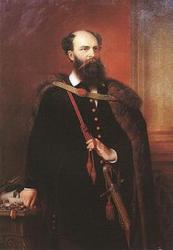
Nikolay Guchkov
- Early Life and Education
- Career in Public Service
- Union of October 17:
- Moscow City Mayor (1905-1912)
- Economic Recovery:
- Infrastructure Development
- Education:
- Health and Welfare:
- Resignation and Legacy
- Influence:
- Later Life and Exile
- Emigration:
Early Life and Education
Nikolai Ivanovich Guchkov was born into a wealthy merchant family in Moscow in 1860. He enrolled in the Faculty of Law at Moscow State University, where he honed his legal knowledge and political views.
Career in Public Service
Gla:In the 1890s, Guchkov joined the Moscow City Duma as a "gla," or elected member. He emerged as a vocal critic of the autocratic city governor, Vladimir Golitsyn.
Union of October 17:
Guchkov played a pivotal role in the establishment of the Union of October 17, a moderate political party advocating for constitutional reforms. He believed in reconciling the interests of different social groups.
Moscow City Mayor (1905-1912)
City Head:After Golitsyn's resignation, Guchkov was elected as City Head of Moscow in 1905. He inherited a city in chaos following the December 1905 uprising.
Economic Recovery:
Despite the financial crisis, Guchkov implemented a bold economic agenda. He restructured city finances, balancing the budget and increasing revenues. He also promoted trade and industry, revitalizing the city's economy.
Infrastructure Development
Tram Network:Guchkov oversaw the development of one of the most advanced tram networks in Russia, connecting all major districts.
Education:
He made education a top priority, establishing free and universal primary education in Moscow.
Health and Welfare:
Guchkov played a significant role in establishing the Moscow Red Cross, providing aid to the poor and vulnerable.
Resignation and Legacy
Departure:In 1912, Guchkov resigned as City Head but continued to serve as a member of the Duma.
Influence:
His tenure as City Head transformed Moscow into a thriving metropolis. His legacy includes a modern transportation system, an expanded education system, and a revitalized city economy.
Later Life and Exile
WWI:During World War I, Guchkov served as a representative of the City Duma on the Central Military-Industrial Committee, supporting the war effort.
Emigration:
After the Bolshevik Revolution in 1917, Guchkov fled to the south and eventually emigrated to Paris in 1920, where he passed away and was laid to rest.