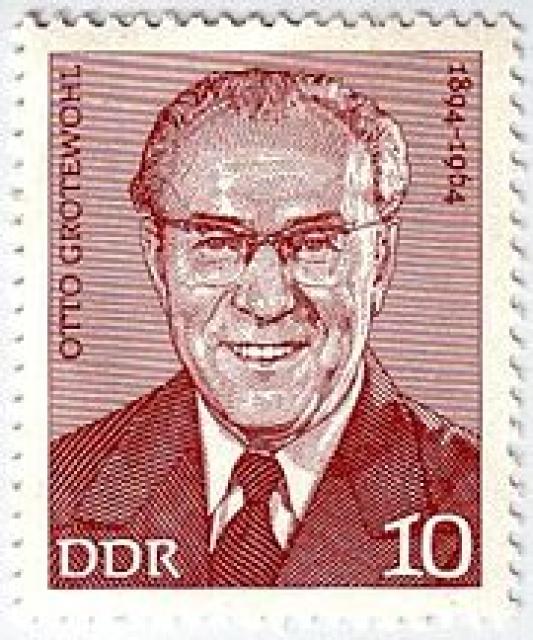
Otto Grotevol
German politician.
Country:  Germany
GermanyBiography of Otto Grotewohl
Early Life and Political Career
Otto Grotewohl was a German politician and member of the Socialist Unity Party of Germany (SED) from 1946. He served as the Chairman of the Council of Ministers of the German Democratic Republic (GDR) from 1949 to 1964. In 1908-1912, Grotewohl studied to become a typesetter and after completing his education, he joined the SED. From 1918 to 1922, he was a member of the Independent Social Democratic Party of Germany. In the years 1920-1930, he served as a deputy in the Landtag of Brunswick for the SED. In 1921, he also held the position of Minister of Education in the Free State of Brunswick, and in 1923, he became the Minister of the Interior and Justice. In 1925, Grotewohl became a member of the Reichstag. However, with the rise of the Nazis to power in 1933, he was removed from his position and forced to leave Brunswick. He relocated to Hamburg and later settled in Berlin in 1938, where he engaged in trade and industrial representation.
Resistance and Arrest
While in Berlin, Grotewohl joined the resistance group led by Erich Gniffke, whom he had known since his time in Brunswick. In August 1938, Grotewohl was arrested and stood trial for alleged treason before the so-called "People's Court." The trial, however, was postponed for seven months.
Post-War Activities
On July 17, 1945, Grotewohl, along with Erich Gniffke, Max Fechner, Gustav Dahrendorf, and Herman Garnish, signed an appeal calling for the establishment of the Social Democratic Party of Germany (SDPG). Grotewohl assumed the position of Chairman of the Central Committee of the SDPG and soon advocated for the swift unification of the party with the Communist Party of Germany (CPG). According to contemporaries Egon Bar and Jakob Kaiser, Grotewohl changed his position on this matter after a conversation he had been summoned to at the headquarters of the Soviet occupation authorities in Karlshorst. Jakob Kaiser speculated that there might have been something in Grotewohl's biography during his time in Brunswick that allowed for pressure to be exerted on him.
Leadership and Retirement
On March 31, 1946, after heated internal party debates in West Berlin, a preliminary vote was held among members of the SDPG. More than 80 percent of the participants answered negatively to the question "Are you in favor of an immediate merger of both labor parties?" No preliminary vote was conducted in East Berlin. However, Grotewohl had initially been in favor of the merger of both left-wing parties. On April 22, 1946, the SDPG and CPG merged in East Berlin to form the new party SED. Grotewohl and former CPG member Wilhelm Pieck were elected as co-chairs. In 1948, Grotewohl became the Chairman of the Constitutional Committee of the German People's Council, the predecessor to the People's Chamber of the GDR. In 1949, Grotewohl was elected as the Chairman of the Council of Ministers of the GDR. Despite sharing equal leadership with Pieck in the party, Pieck, under the guidance of the Soviet occupying authorities, managed to acquire greater power. A year later, Grotewohl signed the Görlitz Agreement, which solidified the border between Germany and Poland along the Oder-Neisse line. In 1955, Grotewohl supported the Rapacki Plan for the creation of a confederation in Germany. Due to a severe illness in 1960, Grotewohl retired from active political life and lived in seclusion in the village of Wandlitz. He passed away in Berlin in 1964.
Legacy and Honors
Grotewohl was not only a politician but also an enthusiastic artist and amateur filmmaker. He was awarded the Order of Lenin, the Order of Karl Marx, and the Gold Order for Merit to the Fatherland of the GDR. He is also an honorary citizen of the city of Dresden.