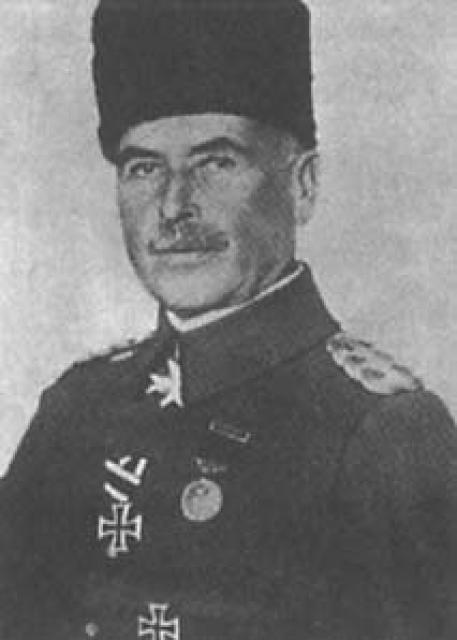
Otto Liman
 Germany
Biography of Otto Liman
Otto Liman was a German cavalry general who was born in 1855. He received his education at the Military Academy in 1881. In March 1874, he joined the 115th Infantry Regiment and served in the 23rd Dragoon Regiment from 1879. In 1886, he became an adjutant in the 21st Cavalry Brigade. From 1887, he served in the General Staff and in 1891, he became the commander of the squadron in the 20th Dragoon Regiment. In 1893, he held staff positions in the 22nd Division and the XI Army Corps.
In 1900, Liman became the commander of the 6th Hussar Regiment and in 1906, he was appointed as the commander of the 15th Cavalry Brigade. In 1908, he became the inspector of the 4th Cavalry Inspection and in 1911, he became the chief of the 22nd Division. In December 1913, Liman became the head of the military mission in Turkey, which initially consisted of 70 officers but grew to around 800 by the end of the war. He was responsible for reorganizing the Turkish army.
At the start of the war, Liman became the German authorized representative in the Turkish Supreme Command. He was also given command of the I Army Corps, stationed in Constantinople, which caused a serious diplomatic crisis after a protest from the Russian Ministry of Foreign Affairs. In January 1914, he became the general inspector of the Turkish army.
After the Ottoman Empire entered the war, Liman was appointed as the commander of the 1st Turkish Army deployed in Asia Minor to defend the Black Sea coast. He later became the commander of the 2nd Turkish Army. In late March 1915, under Liman's command, the 5th Turkish Army was formed in the area of the Dardanelles, consisting of 5 infantry divisions from the 1st and 2nd armies. By April 1915, its strength had reached 60,000 personnel.
Liman gained fame for his defense of the Dardanelles from February 1915 to January 1916. An attempt by the Anglo-French fleet to force the Dardanelles Strait ended in complete failure, and the Allied forces that landed on the Gallipoli Peninsula under the command of General Ian Hamilton suffered heavy losses. In August 1915, Liman's army (14 divisions) halted the Allied advance on Gallipoli, forcing the Anglo-French command to decide on an evacuation, which was completed on January 9, 1916. The Allies' losses amounted to around 271,000 personnel, while Turkey lost 250,000 personnel, including 76,000 killed or died from wounds and diseases. After the victory at Gallipoli, Liman was hailed as the "Hindenburg of the East" in Turkey.
Following the Gallipoli campaign, Liman's army was left to defend the straits. Around 36,000 personnel were stationed in Izmir, 30,000 in Denizli, and 30,000 in Dinar. On January 10, 1916, he was awarded the Pour le Merite order and oak leaves. On February 25, 1918, Liman replaced General Erich von Falkenhayn in Palestine as the commander of the Turkish-German army group "F" (also known as "Yildirim" or "Lightning"), which included the 4th (General Djemal Pasha Mersinli), 7th (General Mustafa Kemal Pasha), and 8th (General Cevat Pasha) armies, totaling 34,000 personnel, 402 artillery pieces, and 25 aircraft. Later, the 2nd Army (General Nihad Pasha) also joined the group. They planned to launch an offensive at the end of February or early March 1918, but they lacked sufficient forces. On February 21, British forces captured Jericho. After the Turkish army began to collapse, Liman's forces were decisively defeated by General Edmund Allenby's British forces in the Palestinian campaign from September 19 to October 1, 1918. On October 1, Liman surrendered Damascus, on October 6, Beirut, and on October 26, Aleppo. As a result, he was forced to surrender most of Mesopotamia, practically all of Palestine, and Syria. The army group was defeated, and a large part of it (around 75,000 personnel) surrendered as prisoners of war. On October 5, the Turkish government requested an armistice from the Allies, and on October 31, military operations in Mesopotamia and Palestine ceased. Liman handed over command to Mustafa Kemal Pasha on October 31, 1918, but officially remained at the head of the army group until March 17, 1919. After the war, he retired from military service. He authored the memoir "Five Years in Turkey" in 1920.




