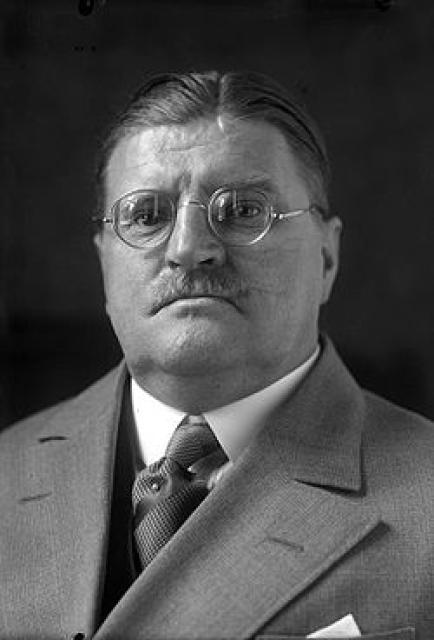
Otto Meisner
 Germany
Biography of Otto Meissner
Otto Meissner was a German politician who served as the chief of the presidential cabinet during the Weimar Republic, under presidents Friedrich Ebert and Paul von Hindenburg, and at the beginning of the Nazi era under Adolf Hitler. He was born in Bischwiller, Alsace, in a family of a postal worker. Meissner studied law at the University of Strasbourg from 1898 to 1903 and became a member of the Brotherhood of Young Students in Strasbourg. He later moved to Berlin and obtained a doctorate in law in 1908 from Erlangen, Bavaria. Meissner worked for some time at the national railway in Strasbourg.
In between 1915 and 1917, Meissner served in the infantry regiment during World War I. He then shifted to rear service activities and worked in Bucharest and later in Kiev. Eventually, Meissner became a German business agent for the Ukrainian government. Thanks to his previously established connections, Meissner became an advisor to the head of state's office in 1919, when Friedrich Ebert, a social democrat, held the position. By 1919, he had risen to the position of director of the ministry and head of the chancellery. In 1923, Meissner was appointed state secretary by Ebert, and he retained this position under Paul von Hindenburg, who succeeded Ebert.
In 1934, when Adolf Hitler unified the roles of head of state (Reich President) and head of government (Chancellor), Meissner's chancellery was renamed the presidential chancellery, and his responsibilities and sphere of influence were significantly reduced. In 1937, Meissner was appointed as the newly created position of state minister and head of the presidential chancellery under Hitler and Chancellor. After World War II, Meissner was arrested by the Allied forces and interrogated as a witness during the Nuremberg trials. In July 1947, he became one of the main figures in the case against former state secretary Dr. Schlegelberg. In 1949, Meissner himself was accused in the Wilhelmstrasse case, but he was acquitted by the court in January 1952.
Meissner is particularly interesting in terms of history as a person who had significant influence on Germany's leaders, especially Paul von Hindenburg. Along with Kurt von Schleicher and several other political figures, Meissner organized the dissolution of the parliamentary system from 1929 to 1939 through the means of the civil presidential cabinet alone. Meissner's role in appointing Adolf Hitler as the chancellor in December 1932 remains unclear. Undoubtedly, Meissner had sufficient resources to exert certain influence on the country's politics. It was Meissner who organized negotiations with Hitler regarding the removal of von Schleicher. On the Nazi side, this "project" was handled by Kepler, Ribbentrop, and Kurt Freiherr von Schröder. Hitler and Hindenburg actively avoided contact with each other due to their mutual dislike.
In 1933, Meissner attempted to resign, but his request was rejected. From 1937 onwards, the Nazis made him a federal minister. However, it should be understood that, despite the prestigious title, his real power during Hitler's time was quite limited. In 1950, Meissner published his memoir, "State Secretary under Ebert, Hindenburg and Hitler," detailing his challenging bureaucratic journey.