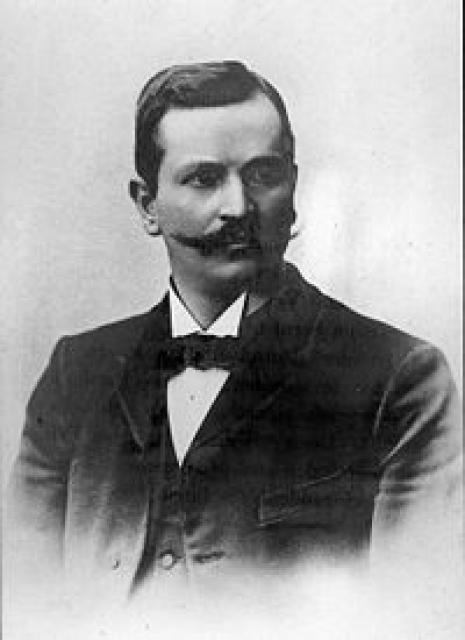
Paul Drude
 Germany
- Paul Drude: A Pioneer in Electromagnetic Theory
- Early Life and Education
- Scientific Contributions
- Academic Career
- Legacy
Paul Drude: A Pioneer in Electromagnetic Theory
Paul Drude was a distinguished German physicist who made significant contributions to the field of electromagnetism.
Early Life and Education
Born in Braunschweig, Germany, Drude completed his studies at the University of Göttingen, where he excelled in physics.
Scientific Contributions
Drude's primary research focused on the applications of classical electron theory to various physical phenomena.
Electronic Theory of Metals:He developed a theory of electronic conduction in metals, explaining the properties of electrical currents in metallic materials.
Polarization of Light:Drude proposed a theory of light polarization upon reflection from metallic surfaces, describing the behavior of polarized light interacting with metal interfaces.
Dispersion of Light:He discovered and elucidated the phenomenon of anomalous dispersion in dielectric materials, later clarified by Debye's theory.
Dielectric Measurements:Drude devised methods for measuring the dielectric constant and absorption coefficient of liquid dielectrics in the microwave and VHF frequency ranges.
Academic Career
Drude's academic pursuits included professorships at various prestigious universities:
Professor at Leipzig (1894):He made significant contributions to Leipzig's physics department.
Professor at Gießen (1900):He continued his groundbreaking research while teaching at Gießen.
Professor at Berlin (1905):Drude became a highly influential figure in Berlin's scientific community.
In addition, Drude served as editor of the esteemed journal "Annalen der Physik" from 1900 onwards.
Legacy
Paul Drude's scientific legacy continues to inspire generations of physicists. In recognition of his contributions, the International Astronomical Union named a crater on the Moon's far side after him in 1970.