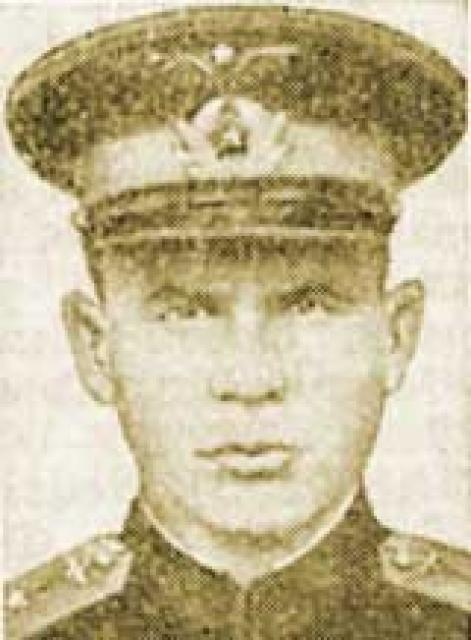
Pavel Blinov
 Kazakhstan
Biography of Pavel Fyodorovich Blinov
Pavel Fyodorovich Blinov, a military pilot and Hero of the Soviet Union, was born on September 20, 1919, in the village of Vyazovka in the Bazarnokarabulaksky District of Saratov Oblast. He was a Russian national. Blinov graduated from School No. 1 in the city of Volsk, Saratov Oblast, in 1938 and worked at a factory. In 1940, he entered a military aviation school in Engels. After graduating from the school, he served in the Izhevsk Military Aviation School for Initial Pilot Training from 1941. From March 1943 until the victory over Germany in the Great Patriotic War, Blinov fought as part of the 5th and 2nd Air Armies on the Northwestern, Voronezh, Steppe, 2nd, and 1st Ukrainian Fronts. He participated in the Battle of Kursk, the liberation of Ukraine, Moldavia, Romania, Poland, Czechoslovakia, and the defeat of the enemy on German territory. Blinov was severely wounded in the head on December 15, 1943. He was awarded two Orders of the Red Banner (1943, 1944), Orders of Alexander Nevsky (1945), the Order of the Patriotic War 1st Class (1943), the Order of the Red Star (1943), the medals "For the Capture of Berlin," "For the Liberation of Prague," and two other medals for his combat achievements. The title of Hero of the Soviet Union, along with the Order of Lenin and the Gold Star medal, was awarded to Pavel Fyodorovich Blinov on April 10, 1945, for his 96 combat sorties on the Il-2 assault aircraft, causing significant damage to the enemy and demonstrating courage and bravery.
During the war years, Blinov destroyed 3 bombers on airfields, 24 tanks, 12 anti-aircraft guns, 5 artillery positions, 207 vehicles with infantry and cargo, a bridgehead, 14 railway wagons, 7 warehouses with ammunition and fuel, and 350 enemy soldiers and officers. This courageous pilot participated in 29 aerial battles, during which he, as part of a group, shot down 5 Me-109 and FW-190 fighters. Blinov became a reserve lieutenant colonel in 1946. From 1948 to 1961, he served in the Ministry of Internal Affairs. In 1955, he graduated from the Higher Fire and Technical Courses in Moscow. Blinov lived in Alma-Ata. A street in the city of Volsk is named after him.
The Attack on the Hushi Airfield
In May 1944, the enemy's aviation intensified its actions in the area of the 2nd Ukrainian Front. Bombers struck at the railway junctions of Beltsy, Veresti, Larga, Botoshany, as well as at our headquarters and rear communications. They operated primarily from the Romanian Hushi airfield, south of the city of Iasi. On May 29, a group of 12 Il-2 aircraft, including Blinov, received the task of striking the Hushi airfield and destroying enemy aircraft. The takeoff was made at dawn, while it was still dark, with the aim of catching the planes on the airfield before they took off on their mission. The pilots knew that the Hushi area was heavily defended by anti-aircraft artillery. Therefore, the attack aircraft flew at low altitude and high speed to strike before the anti-aircraft guns could open fire. The plan succeeded. Blinov dropped bombs on the aircraft parking area and noticed with satisfaction that the Junkers aircraft caught fire. Only now, after the first attack, did the anti-aircraft gunners open fire. The Il-2s unleashed all their firepower on them. One gun fell silent, then another, and another. Blinov attacked the fourth gun and shot its crew at point-blank range.
Maneuvering in altitude and horizontal flight, the Il-2s made a third approach. Spotting a bomber parked at the edge of the airfield, Blinov fired a long burst at it. At first glance, the aircraft remained undamaged, but as soon as Blinov gained altitude to assess the situation and make the next approach, the Junkers began to emit smoke, and then burst into flames. Other squadrons of attack aircraft that followed Blinov's group completed the destruction of the enemy airfield.
Actions in Lviv
In July 1944, Blinov and his regiment were transferred to the Lviv direction. Clearing the way for the advancing troops of the 1st Ukrainian Front, the pilots made three to four sorties per day, delivering powerful strikes on the enemy's strongpoints and resistance pockets. The battles for the expansion and retention of the Sandormir bridgehead in August 1944 were particularly fierce. On August 13, Blinov led a squadron of six Il-2s to attack counterattacking tanks in the area of Stopnitsa. With accurate attacks from a low flying altitude, his group destroyed six tanks, thwarting the German attack.


