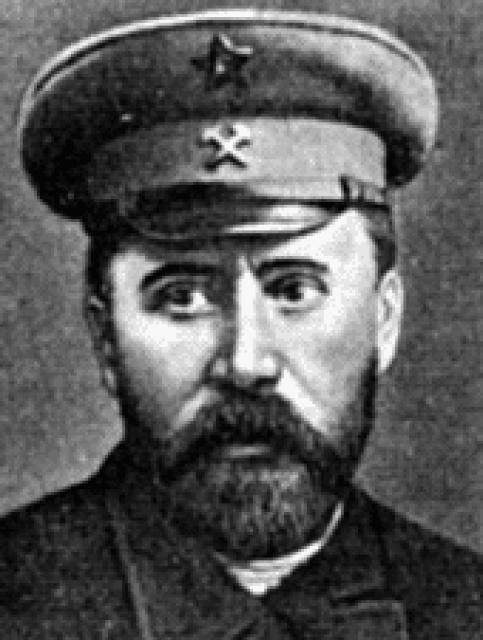
Petr Kobozev
- Early Life and Education
- Railway and Engineering Career
- Political Activism and Exile
- Revolutionary Period
- Commissioner of the Tashkent-Orenburg Railway
- High-Level Government Positions
- Extraordinary Commissioner in Central Asia and Siberia
- Minister of Railways
- Military Leadership
- Work in Turkestan
- Later Career and Scientific Contributions
- Legacy and Honors
Early Life and Education
Born into a peasant family, the future statesman and party leader attended a theological school and then the Moscow Theological Seminary. However, he was expelled due to his involvement in the 1895 seminary revolt.
Railway and Engineering Career
Subsequently, he worked as a railway mechanic, assistant driver, and driver. In 1898, he graduated from the Moscow Real School and enrolled in the Moscow Higher Technical School. He specialized in engineering technology.
Political Activism and Exile
In 1899, Kobozev was arrested and exiled to Riga due to his political affiliations. Despite this, he continued his studies at the Riga Polytechnic Institute, where he played various roles in student organizations and assisted professors.
After graduating as an engineer, he worked at the Russo-Baltic Wagon Factory in Riga. He also became involved in the Riga Committee of the Russian Social Democratic Labor Party and served as one of the leaders of the military organization for the Latvian Social Democratic Party.
Revolutionary Period
With the outbreak of the 1905 revolution, Kobozev was dismissed from his job and engaged in strike and demonstration organization in the Caucasus oil fields. He later worked in Moscow, overseeing the installation of heating systems and organizing railway workers.
After another arrest, he was sent to Riga, where he taught at private institutions. In 1915, he was exiled to Orenburg for his political activities and worked on the construction of the Orenburg-Orsk railway. He co-founded the Orenburg branch of the Bolshevik Party and served on its committee.
Commissioner of the Tashkent-Orenburg Railway
Following the February Revolution of 1917, Kobozev was released from prison and elected commissioner of the Tashkent-Orenburg railway at its inaugural convention. In May 1917, he was summoned to Petrograd by the Central Committee of the Bolshevik Party.
High-Level Government Positions
He was elected to the city Duma and served as chief inspector of educational institutions within the Ministry of Railways in the Provisional Government. Kobozev also played a role in preparing the October Revolution and attended the Second All-Russian Congress of Soviets as a Bolshevik delegate.
Extraordinary Commissioner in Central Asia and Siberia
From November 1917 to February 1918, Kobozev served as Extraordinary Commissioner of the All-Russian Central Executive Committee and Council of People's Commissars in Central Asia and Western Siberia. He led the fight against Cossack leader Alexander Dutov's uprising.
Minister of Railways
In May 1918, Kobozev was appointed as the first People's Commissar of Railways in the Soviet government. He played a key role in reorganizing the railway system and oversaw the creation of an experimental railway research institute.
Military Leadership
From June 13 to July 23, 1918, Kobozev served as a member of the Revolutionary War Council of the Eastern Front. He was involved in the formation of the Red Army and participated in operations against the Czechoslovak Legion and internal counter-revolutionaries.
Work in Turkestan
As Chairman of the Central Executive Committee of the Turkestan Soviet Socialist Republic (1918-1919), Kobozev focused on cultural development, promoting education, literacy, and the arts. He also played a role in nationalizing the Baku oil fields and organizing the transportation of oil to Central Russia.
Later Career and Scientific Contributions
Due to health reasons, Kobozev transitioned to academia in 1923. He served as professor and rector of the Moscow Land Survey Institute and the Leningrad Polytechnic Institute. In 1938, he earned a doctorate in technical sciences and continued to conduct research in various fields.
Legacy and Honors
Kobozev is buried in the Novodevichy Cemetery in Moscow. His contributions to the Soviet railway system and the development of Turkestan are highly regarded.



