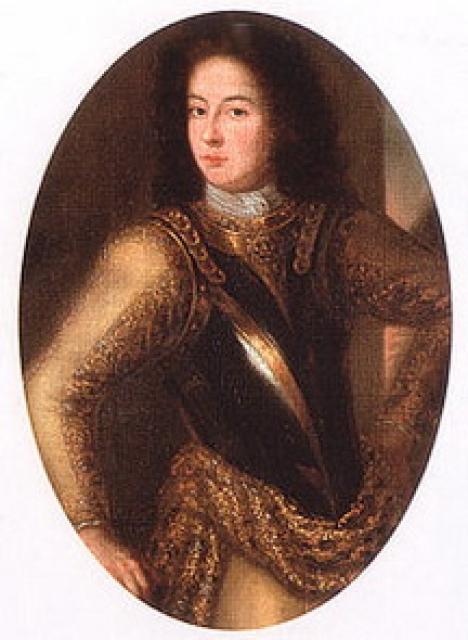
Philipp Christoph Graf von Konigsmarck
 Germany
Philipp Christoph Graf von Königsmarck was a Hanoverian officer and courtier whose dramatic disappearance in 1694 became one of the great scandals of the German princely courts. Born into a family with a strong military tradition, he served first in the Habsburg army and later at the Hanoverian court. His name became inseparable from his reported relationship with Sophie Dorothea, wife of the Hanoverian heir George Louis, and the mystery surrounding his final hours.
Family and early life
Königsmarck was born in Stade on March 14, 1665, into the noble Königsmarck family. His father, Kurt Christoph von Königsmarck, was a general who died while serving in the Dutch army in 1673. His grandfather was the Swedish field marshal Hans Christoff von Königsmarck, while his sister Maria Aurora became a prominent countess and cultural figure. Philipp Christoph grew up in a world where military service, travel, and court connections shaped the prospects of a young nobleman.
Like many well-born men of his time, he undertook a grand tour and made a brief study visit to Oxford, where he received an honorary medical doctorate. He then pursued an officer’s career in imperial service, taking part in campaigns in Hungary between 1684 and 1687.
A soldier at the Hanoverian court
In 1689 Königsmarck entered the service of the House of Hanover. He became a colonel and regimental commander, combining a military role with life as a courtier. In the early 1690s, he was closely associated with Sophie Dorothea, the wife of the heir to Hanover, George Louis, who would later become King George I of Great Britain.
Their relationship and surviving correspondence have fueled centuries of fascination. Modern biographical accounts describe the attachment as passionate and point to letters documenting an intimate relationship. The court, however, was a tightly watched place, and the possibility that Sophie Dorothea and Königsmarck planned to flee together made the situation politically explosive. In 1694, Augustus the Strong, Elector of Saxony, appointed Königsmarck a general, offering him a new position as the couple’s plans reportedly came to a head.
The disappearance of 1694
Königsmarck vanished in Hanover during the night of July 11–12, 1694. The prevailing historical account is that he was murdered inside the Leineschloss by courtiers acting to prevent the planned escape and suppress the scandal. A modern entry in the Neue Deutsche Biographie identifies four court figures as involved and names the Italian cleric Don Nicolò di Montalban as the man who struck the fatal blow. Königsmarck’s body was never publicly recovered and was believed to have been thrown into the Leine River.
The Hanoverian court denied responsibility, and the absence of a body or a public investigation left room for speculation. The broad outline is well established in biographical scholarship, but the precise sequence of events and the degree of direct involvement by senior members of the court remain part of the case’s enduring mystery.
Aftermath and legacy
Sophie Dorothea’s marriage to George Louis was dissolved later in 1694, and she was confined for the rest of her life at Ahlden, becoming known as the Princess of Ahlden. Officially, the separation was not framed as punishment for adultery. Königsmarck, who was unmarried, left no known descendants.
His place in history rests less on his military record than on the collision of court politics, forbidden love, and a disappearance that was never fully explained. The missing count became a lasting figure in Hanoverian history, while the fate of Sophie Dorothea transformed the affair into a story of personal tragedy and dynastic control.


