Phrederik I
 Denmark
- Biography of Frederick I
- Early Life
- Failed Expedition
- Reign as King
- Support for Reformation
- Personal Life
Biography of Frederick I
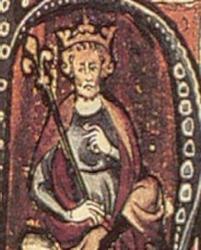
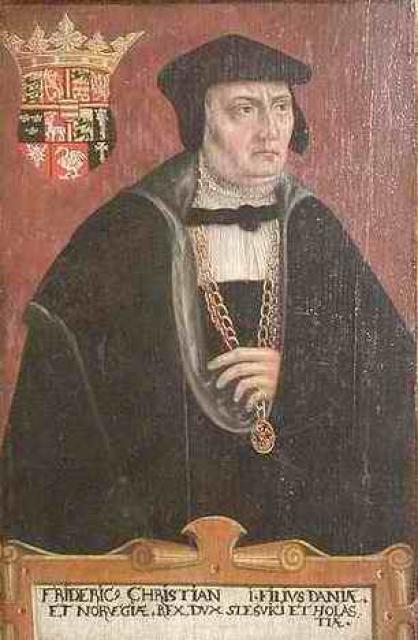
Frederick I, born on March 26, 1523, was the son of Christian I of Denmark and Dorothea of Brandenburg. He belonged to the Oldenburg dynasty and became the King of Denmark on March 26, 1523, after overthrowing his nephew Christian II. He also became the King of Norway on August 23, 1524 and the Duke of Schleswig-Holstein.
Early Life
In 1482, at a young age, Frederick was elected Duke of Schleswig-Holstein along with his older brother, King Hans of Denmark, after the death of their father. When Frederick reached adulthood in 1490, the duchies were divided between the brothers.
Failed Expedition
In 1500, Frederick persuaded his brother to start a war against Ditmarsh, a region in modern-day Germany. They assembled a massive army not only from Schleswig-Holstein but also from other countries within the Kalmar Union. Numerous German mercenaries also participated in the war on Denmark's side. However, the expedition failed, and the Danish troops were defeated in the Battle of Hemmingstedt. One-third of the knights from Schleswig-Holstein perished in this battle.
Reign as King
In 1523, Frederick's nephew, Christian II, the King of Denmark, Norway, and Sweden, abdicated the throne due to an uprising by the nobility. Frederick then ascended the throne as Frederick I. Shortly after, he also became the King of Norway. In 1513, when King Hans passed away, a group of nobles from Jutland had already proposed Frederick to take the throne, but he declined the offer, correctly assessing the loyalty of most Danish nobility to Prince Christian.
During his reign, Frederick spent most of his time in Gottorp Castle in Schleswig. He made short visits to Denmark, but he never visited Norway. His reign was tumultuous, and his position as king was precarious, as Christian, who had been dethroned, constantly posed a threat. In 1531, Christian invaded Norway and threatened to take the Danish throne with the support of Holy Roman Emperor Charles V. In 1532, Frederick managed to capture Christian and imprison him in Sønderborg Castle. He reached a diplomatic agreement with Charles V and maintained peace until his death.
Support for Reformation
During his reign, Frederick had to suppress peasant uprisings while Protestantism gained strength. He began to support the emerging Reformation movement in Denmark and took the Lutheran clergy under his patronage. With the support of the nobility, he significantly curtailed the rights and privileges of the Catholic clergy in Denmark. Despite not possessing exceptional governing abilities, Frederick managed to avoid open conflicts.
Personal Life
In 1502, Frederick married Anne of Brandenburg, and they had two children: Christian III, who would later become king, and Dorothea, who married Duke Albert of Prussia. After becoming a widower, Frederick married Sophie of Pomerania in 1518. They had several children, including Hans, Elizabeth, Adolf, Anna, Dorothea, and Frederick. Frederick's son Christian III succeeded him as king upon his death.
Overall, Frederick I's reign was marked by political challenges, military failures, and religious changes. Despite the difficulties, he managed to maintain his position as king and support the early stages of the Reformation in Denmark.