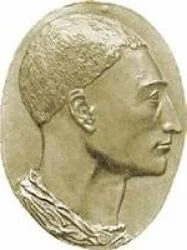
Pius II
 Holy Roman Empire
- Childhood and education
- A humanist in the councils and courts
- The papacy and the crusade that never sailed
- Pienza and the writer’s legacy
Before he became Pope Pius II, Enea Silvio Piccolomini was already a celebrated Renaissance writer, diplomat, and political operator. His life took him from the Tuscan countryside to the Council of Basel and the courts of Europe, then to the papal throne. The same man who once defended the authority of church councils later became one of the strongest advocates of papal supremacy, while his grand plan to unite Christian Europe against the Ottoman Empire ended with his death at the Adriatic port of Ancona.
Childhood and education
Piccolomini was born on October 18, 1405, in Corsignano, a small town near Siena in the Holy Roman Empire. His family belonged to the Sienese nobility but had fallen on hard times. He studied law and the humanities at Siena and Florence, developing a command of classical literature and rhetoric that would become central to his career. Rather than remain a provincial scholar, he used his writing and eloquence to win patrons and enter the world of diplomacy.
His literary talents made him a conspicuous figure well before his election as pope. In 1444 he wrote Historia de duobus amantibus, a Latin tale of two lovers that circulated widely in Europe. Its frank, worldly subject matter stood in marked contrast to the ecclesiastical role he would later assume. The work belongs to his life as a lay humanist and should not be confused with the later image of a pope devoted to church reform and crusade.
A humanist in the councils and courts
In 1432 Piccolomini traveled to the Council of Basel as secretary to Cardinal Domenico Capranica. The council became a battleground over whether a general council could claim authority above the pope. Piccolomini aligned himself with the conciliar movement and served the council and, later, the antipope Felix V. His position was not permanent: as his diplomatic career advanced, he moved toward reconciliation with the papacy, a turn that would later define his own pontificate.
In 1442, Emperor Frederick III crowned him poet laureate and brought him into the imperial chancery. Piccolomini became a skilled envoy, helping negotiate between the emperor, German princes, and Rome. He was ordained a priest in 1447 and rose through church office, becoming bishop of Trieste and then Siena. In 1456 Pope Calixtus III made him a cardinal. When elected pope on August 19, 1458, he took the name Pius II.
The papacy and the crusade that never sailed
Pius tried to turn the papacy into the center of a united European response to Ottoman expansion after the fall of Constantinople in 1453. In 1459 he summoned Christian rulers to a congress at Mantua. The gathering produced little practical commitment: rivalries and political calculations outweighed the pope’s appeals. He continued to press the cause, including in a remarkable letter addressed to Sultan Mehmed II that invited the conqueror of Constantinople to embrace Christianity.
His commitment to the crusade was personal as well as diplomatic. In 1464, despite failing health, Pius traveled to Ancona, where he hoped to meet the fleet and troops for the expedition. The forces assembled slowly, and the pope died there on August 14, before the campaign could begin. The crusade he had spent years advocating never took shape under his leadership.
His papacy also marked a striking reversal on church governance. Having once championed conciliar authority, Pius issued the bull Execrabilis in 1460, condemning appeals from a pope to a general council. This was no small change of emphasis: it reflected his transformation from a council’s advocate into the head of an institution determined to defend papal primacy.
Pienza and the writer’s legacy
Pius’s relationship with his birthplace gave him an architectural legacy as well as a literary one. He elevated Corsignano and reshaped it as Pienza, commissioning a planned civic center with a cathedral and papal residence. The town became a Renaissance experiment in urban design, embodying the humanist ideal that architecture and public life could be deliberately ordered.
He also left an unusually personal record of his age. His Commentaries, written during the final years of his life, recount his career and pontificate in a polished, self-conscious narrative modeled on classical history. It is an invaluable source for the fifteenth century, but also a crafted portrait by a gifted author keenly aware of how posterity would judge him.
Pius II remains a complex figure: a writer who became a pope, a former conciliarist who enforced papal authority, and a diplomat whose bold crusading vision foundered on Europe’s divisions. His achievements in humanist literature and the making of Pienza endured, even as the military unity he sought remained beyond reach.