
Pol Pot
 Cambodia
- Pol Pot: Leader of the Khmer Rouge
- A Brutal Regime
- Early Life and Education
- A Radical Turn
- Rise to Power and Fall
- A Controversial Legacy
Pol Pot: Leader of the Khmer Rouge
Pol Pot was the leader of the Cambodian communist movement known as the Khmer Rouge. He served as the Prime Minister of Democratic Kampuchea from 1976 to 1979 and was the main perpetrator of the genocide committed by the Khmer Rouge. During his three and a half years in power, Pol Pot attempted to "purify" the country by eliminating "undesirable people," resulting in the deaths of 25-40% of the population in Cambodia.
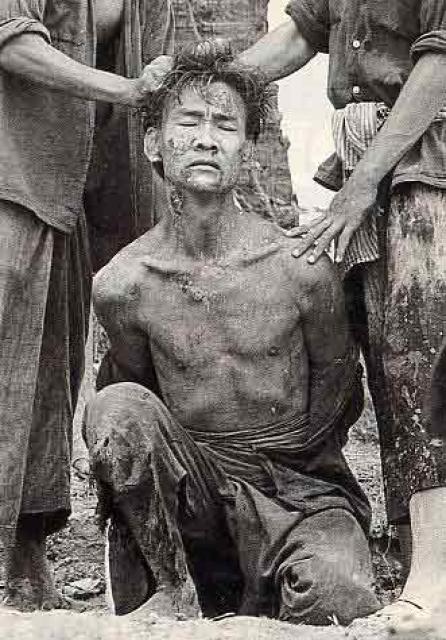
A Brutal Regime
According to various sources, the Khmer Rouge killed between 1.5 to 3.5 million people, including the elderly, women, and children. Religious communities, such as Christians and Muslims, were particularly targeted, with tens of thousands being completely wiped out, including children. Buddhists also faced severe persecution. The regime also targeted the bourgeoisie, intellectuals, and professionals, leaving the country with very few educated individuals. Urban dwellers were also subject to forced relocation and labor, as Pol Pot aimed to create an agrarian utopia.

Early Life and Education
Pol Pot, whose real name was Saloth Sar, was born on May 16, 1928, into a well-off Chinese-Khmer family. At the age of seven, his parents sent him to a Catholic school in Phnom Penh. His sister served as a concubine to King Sisowath Monivong, and Pol Pot often visited the royal palace. In 1947, he received permission to continue his education at the prestigious Lycée Sisowath, but he was not particularly diligent in his studies and transferred to a technical school. It was at this school that he met his future first wife Khieu Ponnary, her sister Thiridith, and Thiridith's future husband Ieng Sary, who would later become Pol Pot's right-hand man.
A Radical Turn
From 1949 to 1953, Pol Pot studied radio electronics in Paris on a government scholarship. The expectation was that he would return to Cambodia and contribute to the country's prosperity. However, in 1951, Pol Pot joined a communist cell, was expelled from university, and returned to Cambodia with plans to transform his country into an ideal communist state. He believed that the true proletariat consisted of uneducated peasants, which led to the purges that followed. In Cambodia, Pol Pot focused on recruiting and organizing his supporters, primarily targeting the poorest segments of the population, eventually giving rise to the Khmer Rouge. Many rural teenagers joined the movement, convinced that it would free them from poverty.
Rise to Power and Fall
Following a bloody civil war, Pol Pot became the leader of Cambodia in 1975. However, in 1979, after the invasion of Vietnam, the Khmer Rouge government collapsed, and Pol Pot fled to the jungles in southwest Cambodia. He clung to the remnants of power for several years, waging a partisan war against the government forces and hiding in inaccessible areas. In 1985, he escaped to Thailand, where he remained in hiding for nearly six years before relocating to China. In 1989, he returned to Cambodia and attempted to continue the fight. However, in 1995, Pol Pot suffered a stroke that paralyzed the left side of his body.
A Controversial Legacy
In the end, the remaining Khmer Rouge decided to hand over their former leader to an international tribunal. On April 15, 1998, Pol Pot died of a heart attack, and his body was cremated. However, rumors persist that he either committed suicide or was poisoned.


