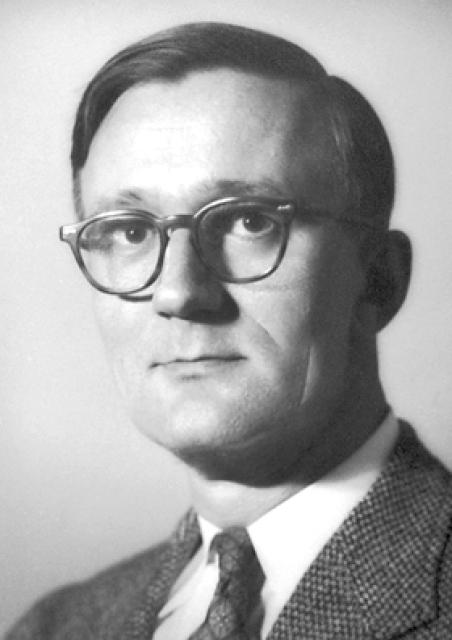
Polikarp Kush
 USA
USABiography of Polykarp Kusch
Polykarp Kusch was an American physicist and Nobel laureate in physics in 1955. He was born in Blankenburg, Germany, to Johann Matthias Kusch, a Lutheran missionary, and Henrietta van der Haas. When Kusch was one year old, his family immigrated to the United States and settled in Cleveland, Ohio. He attended the Cleveland public school and became a naturalized American citizen in 1922. In 1926, he started working as a librarian at the Cleveland Public Library.
Kusch obtained his Bachelor of Science degree from Case Institute of Technology (now Case Western Reserve University) in Cleveland in 1931. He then transferred to the University of Illinois, where he earned his Master's degree in physics in 1933 and his Ph.D. in 1936 with a dissertation on optical molecular spectroscopy. During his time as a graduate student, Kusch worked as an assistant instructor (1931-1936) at the University of Illinois.
After completing his education, Kusch worked as a research assistant at the University of Minnesota in 1936 and became a physics instructor at Columbia University in 1937. During World War II, he conducted research for the defense industry. From 1941 to 1942, he worked as an engineer-researcher at Westinghouse Electric, contributing to the development of microwave electronic tubes for radar. From 1942 to 1944, he worked as a staff member of the Office of Scientific Research and Development at Columbia University, where he focused on high-frequency generators. In 1944-1946, Kusch worked at Bell Telephone Laboratories, where he participated in the design of electronic tubes and microwave generators.
After the war, Kusch became an adjunct professor at Columbia University and was promoted to full professor in 1949. He served as president and dean of faculties from 1969 to 1970 and as vice president for administrative affairs and rector of the college from 1970 to 1971. In the early years of his work at Columbia University, Kusch collaborated closely with Isidor A. Rabi, applying the resonance method to study atomic and molecular properties using molecular beams. Rabi had invented the method of magnetic resonance in 1937, which involved passing a beam of particles through a magnetic field while bombarding it with radiation pulses. The high resolution and accuracy achieved with Rabi's method made it suitable for studying fine particle properties such as atomic energy levels and nuclear magnetic moments.
Kusch's groundbreaking work focused on accurately measuring the magnetic moment of the electron. He collaborated with Henry Foley to measure the ratio of the total internal and total orbital magnetic moments of atomic beams in different energy states. These total moments depend on the intrinsic and orbital moments of individual electrons and are uniquely determined by the atom's energy state. By comparing experimental measurements with theoretical predictions, Kusch and Foley found that the intrinsic magnetic moment of the electron was slightly larger than its orbital magnetic moment by more than 0.1%.
Kusch's and Foley's experimental findings were in full agreement with the theoretical calculations done by Sin-Itiro Tomonaga, Julian Schwinger, and Richard Feynman, which formed the basis of quantum electrodynamics. Their independent research led to the "reformulation of the theory of electron-electromagnetic interaction - the so-called quantum electrodynamics," as stated by Ivar Waller of the Royal Swedish Academy of Sciences when announcing their Nobel Prize in Physics in 1955.
In addition to his scientific achievements, Kusch was known for his love of music and was an avid reader with a wide range of interests. He was a member of the National Academy of Sciences, the American Philosophical Society, and the American Association of Physics Teachers. Kusch received honorary doctorates from Case Western Reserve University, the Ohio and Illinois state universities, Yeshiva University, Colby College, Gustavus Adolphus College, and Incarnate Word College.
Kusch had three daughters with his first wife, Edith Starr MacRoberts, whom he married in 1935. After her death in 1959, he remarried Betty Pecceoni and had two children with her. In 1972, Kusch became a professor of physics at the University of Texas at Dallas and served on the university's board in 1980. In 1982, he was awarded the title of honorary professor.