Ptolemy VIII Physcon
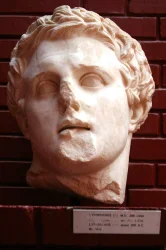
Ptolemy VIII, known as Euergetes II and by the nickname Physcon, ruled Egypt during one of the Ptolemaic dynasty’s most turbulent periods. His long career moved between shared rule, exile in Cyrene and the throne in Alexandria. Rivalries with his brother, sister-wife Cleopatra II and niece-wife Cleopatra III repeatedly divided the kingdom, while surviving royal decrees and temple records reveal a ruler whose reign was more complex than hostile ancient anecdotes suggest.
A prince in a divided dynasty
Born around 182 BCE, Ptolemy was the second son of Ptolemy V and Cleopatra I. He first entered royal government in 170 BCE, ruling alongside his elder brother Ptolemy VI and their sister Cleopatra II. Their joint rule came during a crisis: the Seleucid king Antiochus IV invaded Egypt, and Rome intervened to force his withdrawal. The dynasty survived, but its internal rivalries deepened.
By 163 BCE, Ptolemy VIII had been pushed out of Egypt and established as ruler of Cyrene, a Ptolemaic territory to the west. He remained there until Ptolemy VI died in 145 BCE. Returning to Egypt, Ptolemy VIII claimed the throne and married Cleopatra II, his sister and the widow of his brother. Ancient accounts say that he killed his young nephew, who had briefly been presented as a successor. The exact circumstances come through sources shaped by the dynastic conflict, but the succession was unmistakably violent.
Two queens and civil war
Ptolemy later married Cleopatra III, the daughter of Cleopatra II and Ptolemy VI, while Cleopatra II remained queen. This arrangement brought three members of the royal family into a shared but unstable government. In 132 BCE, conflict erupted into civil war. Cleopatra II briefly gained control in Alexandria, while Ptolemy and Cleopatra III operated from elsewhere. Fighting and political upheaval damaged the kingdom, and many Greek residents and scholars reportedly left Alexandria during the unrest.
After years of conflict and shifting control, Ptolemy and Cleopatra II reconciled around 124 BCE. In 118, the three rulers issued a broad amnesty addressing past offenses and disputes over land, a practical attempt to restore order after the civil war. Their decree survives on papyrus and gives historians a view of the administrative work behind the court intrigues.
Rule and legacy
Ptolemy’s epithet Euergetes means “Benefactor,” a traditional royal title, while Physcon, often translated as “Potbelly,” was a nickname preserved by later writers. Ancient Greek authors often portrayed him as cruel and grotesque, and some accounts describe purges of opponents and the expulsion of scholars from Alexandria. Such reports cannot be ignored, but they also reflect the political hostility surrounding his reign. Royal inscriptions and surviving monuments show that he supported temples and cults across Egypt, presenting himself as a traditional pharaoh and benefactor to Egyptian communities.
Ptolemy VIII died in 116 BCE after ruling Egypt from 145. His death left the throne to another family contest: Cleopatra III ruled with one of their sons, Ptolemy IX, while a second son remained a rival claimant. His reign stands out for its length and its repeated family struggles, but also for the decrees, temple patronage and administrative efforts through which the Ptolemaic state sought to recover from civil war.