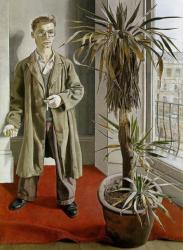
Rene Magritte
 Belgium
Biography of René Magritte
René Magritte was a Belgian artist and one of the prominent surrealists. He was born on November 21, 1898. From 1916 to 1918, Magritte studied at the Royal Academy of Fine Arts in Brussels (Academie Royale des Beaux-Arts). After completing his studies, he worked as a wallpaper designer and a commercial artist.

Early in his career, Magritte's works were influenced by the styles of cubism and futurism, under the influence of Fernand Léger. In 1922, Magritte married Georgette Berger, whom he had met when he was fifteen years old. She became his sole model for his paintings. His encounter with Giorgio de Chirico's metaphysical painting and Dadaist poetry was a significant turning point in Magritte's artistic development.
In 1925, Magritte joined the group of Dadaists and collaborated in the journals Aesophage and Marie with Jean Arp, Francis Picabia, Tristan Tzara, and other Dadaists. In 1926, Magritte painted "The Lost Jockey," his first surrealist painting. From 1927 to 1930, he lived in France, actively participating in the activities of the surrealist group and forming close relationships with Max Ernst, Salvador Dalí, André Breton, and especially Paul Éluard.
In Paris, Magritte's conceptual painting style was fully formed and remained almost unchanged until the end of his life. His paintings constantly evoke a sense of tension and mystery, such as "The Companions of Fear" (1942), "Explanation" (1954), and "Bouquet of Tears" (1948). The night landscape glimmers beneath the illuminated daytime skies in his works, such as "Empire of Light" (1954). Magritte masterfully created contrasts between exquisitely depicted strange combinations of surreal objects and their natural surroundings, often incorporating symbols such as mirrors, eyes, and windows in his canvases, as seen in "The False Mirror" (1935), "The Key to the Space" (1936), and "The Beautiful World" (1962).
Magritte's fascination with philosophy and literature is evident in many of his paintings, such as "Giantess" (inspired by Baudelaire, 1929-30), "The Domain of Arnheim" (inspired by Edgar Allan Poe, 1938), and "Hegel's Holiday" (inspired by Hegel's dialectic, 1958). In the 1940s, Magritte attempted to change his painting style, but the so-called "plein-soleil" period (1945-47) and the "epoque vache" period (1947-48) were not particularly successful, and the artist returned to his original manner of painting.
In the 1950s, Magritte completed two cycles of frescoes: "The Enchantment of Space" for the casino in Knokke-le-Zoute (1953) and "The Ignorant Fairy" (1957) for the Palais des Beaux-Arts in Charleroi. Magritte passed away on August 15, 1967, in Brussels, at the age of 69, due to cancer.