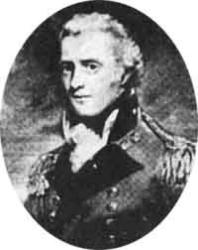
Richard Evell
 USA
USA- Biography of Richard Ewell
- Early Life and Military Career
- Role in the Civil War
- Personal Life and Later Career
Biography of Richard Ewell
Richard Ewell, a career officer in the United States Army and a Confederate army general during the Civil War, gained fame for his service under the command of Stonewall Jackson and Robert Lee. He fought successfully in the early stages of the war but showed some shortcomings in the battles of Gettysburg and Spotsylvania.
Early Life and Military Career
Richard Ewell was born in Georgetown, Washington, D.C. He was the third son of Dr. Thomas and Elizabeth Stoddert Ewell and the grandson of Benjamin Stoddert, the first American Secretary of the Navy. His older brother Benjamin also became an officer and general in the Confederate army.
In 1840, Ewell graduated from West Point as the 13th out of 42 cadets and was commissioned as a second lieutenant in the 1st Dragoons. He served in Santa Fe and on the Oregon Trail with Philip Cooke and Stephen Kearny from 1843 to 1845. He participated in the Mexican-American War under Winfield Scott's command and was promoted to captain for his bravery at the battles of Contreras and Churubusco. During the Battle of Contreras, he conducted night reconnaissance missions alongside his future commander, Robert Lee.
For a time, Ewell served in New Mexico, helping Colonel Benjamin Bonneville settle the territory acquired through the Gadsden Purchase in 1853. In 1859, he was wounded in a skirmish with Apache Indians. In 1860, while commanding Fort Buchanan in Arizona, he fell ill and traveled to Virginia for treatment. He described his condition as "very bad, with dizziness, nausea, etc. I am very weak, and occasionally have chills."
Role in the Civil War
Ewell's illness and previous wounds posed challenges for him at the start of the Civil War. Initially sympathetic to the Union cause, he resigned from the U.S. Army on May 7, 1861, when his home state of Virginia seceded and joined the Confederate army. On May 9, he was commissioned as a colonel in the cavalry and became the first high-ranking officer wounded in the war when a bullet grazed him on June 17 at the Battle of Fairfax Court House.
On June 17, he was promoted to brigadier general in the Confederate army and commanded a brigade in the First Battle of Bull Run. His brigade, positioned on the far right flank of the army, did not see much action. Ewell and Jackson worked well together in battle, although they had some differences in command style. Jackson was strict and religious, while Ewell was more lighthearted, even when it came to religion. While Jackson was often proactive and acted on intuition, Ewell, despite his bravery, needed clear instructions.
During the Valley Campaign, Ewell led his division brilliantly in several battles, defeating larger Union forces commanded by John C. Frémont, Nathaniel Banks, and James Shields. Afterwards, Jackson's army was recalled to Richmond to join forces with Robert Lee's army and face George McClellan's Army of the Potomac. In the Seven Days Battles, Ewell fought well at the battles of Gaines' Mill and Malvern Hill, repulsing the Federal army. However, the Confederate forces faced a new threat from John Pope's Army of Virginia approaching from the north.
On August 9, Ewell defeated General Banks again in the Battle of Cedar Mountain, returned to the Manassas area, and participated in the Second Battle of Bull Run. During the fighting at Groveton, he was wounded, and his left leg had to be amputated below the knee.
Personal Life and Later Career
During his recovery, Ewell was cared for by his cousin, Lizinka Campbell Brown, a widow from Nashville. They had known each other since their youth, and they had a romantic relationship in 1861 during the Valley Campaign. This time, their relationship led to their marriage on May 26, 1863, in Richmond.
Ewell returned to the Army of Northern Virginia just in time for the Battle of Chancellorsville. When Stonewall Jackson was mortally wounded on May 3, he offered Ewell the command of his corps. General Lee temporarily entrusted the corps to Jeb Stuart, but on May 23, Ewell was promoted to lieutenant general, and Lee officially gave him command of the corps (Lafayette McLaws also contested this position). At this time, the army was reorganized into three corps, and Ambrose Hill commanded the newly formed corps.
Despite his previous successes, Ewell's performance at the Battle of Gettysburg in July 1863 was considered subpar. His hesitancy and failure to seize key positions on the first day of the battle allowed the Union Army to occupy favorable ground. This missed opportunity had a significant impact on the outcome of the battle.
Ewell continued to serve in the Confederate army until the end of the war, participating in various campaigns and battles. After the war, he briefly worked as a civil engineer before his death on January 25, 1872, in Tennessee.