Robert Fludd
 Great Britain
Biography of Robert Fludd
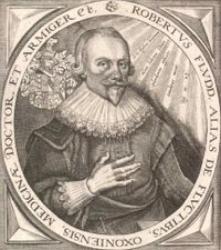
Robert Fludd, an English physician, astrologer, and baroque thinker-mystic, was born into an Anglican family and was the son of a high-ranking government official. Among his ancestors was a leader of one of the Celtic tribes, Cunedda ap Edern. He studied at the University of Oxford and initially pursued a military career before delving into theology, medicine, and the occult sciences. Fludd embarked on extensive travels throughout France, Spain, Italy, and Germany, where he had the opportunity to meet many prominent scholars and acquire significant erudition.
Upon returning to England, Fludd obtained a doctorate in medicine from the University of Oxford. However, in 1606, he faced persecution for his negative views on Galen's teachings. He settled in London, engaging in medical practice and literary activities. Fludd corresponded with Johannes Kepler regarding hermetic traditions and engaged in debates with Marin Mersenne and Pierre Gassendi. His writings, published in eight volumes in folio, were authored under his own name, as well as the pseudonyms Rudolf Otreb and Joachim Frizius.
In medicine, Fludd was a follower of Paracelsus, while in philosophy, he embraced gnostic, neoplatonic, and kabbalistic ideas. Fludd consistently incorporated alchemy and astrology into his reasoning, sometimes even equating the philosopher's stone with Christ. He also proposed several designs for perpetual motion machines. Fludd studied the mechanisms of circulation and based them on the analogy between the macrocosm and microcosm. His observations were later confirmed by William Harvey through empirical experiments.
Although Fludd's membership in the Rosicrucian Order is unverified, he wrote two treatises defending the order. Claims about his affiliation with the Priory of Sion, as well as the existence of the priory itself, fall into the realm of historical mystifications.
Among Fludd's philosophical treatises, notable works include "Philosophia Mosaica" (1638), "Philosophia Sacra et Vere Christiana" (1629), "Utriusque Cosmi Metaphysica, Physica atque Technica Historia" (1617), and "De naturali, supernaturali, praeternaturali et contranaturali microcosmi historia" (1619-1621). These treatises encompass a range of topics, from general inquiries to specific subjects. For example, descriptions of celestial phenomena are followed by pseudoscientific treatises exploring military arts, the application of geometry in painting, and fortress construction. Fludd's philosophical works incorporate diverse elements, intricately woven together, often necessitating visual representations of his abstract ideas. Consequently, his texts, particularly "Utriusque Cosmi Metaphysica, Physica atque Technica Historia," are adorned with elaborate engravings in which the author attempts to elucidate the relationship between divinity and the elements.
Gassendi provided a succinct presentation of Fludd's philosophical views, asserting that Fludd believed his philosophy to be a revelation granted to the first human, which was then transmitted to Moses. Fludd argued that Jesus Christ later retransmitted this doctrine to humanity. In ancient times, Pythagoras, Plato, and Hermes Trismegistus, who were acquainted with Moses' book, partially expressed the true philosophy in their writings, though they remained silent about its source.
Fludd conceived God as the beginning and end of everything, from whom all things arise and to whom all things return. God can be contemplated in two ways: firstly, as an incomprehensible unity in which all distinctions disappear, and secondly, in His manifestations. In the former sense, God is an unfathomable unity, whereas in the latter, He reveals hidden oppositions that exist in the world as an active formal principle of light and a passive material principle of darkness. Light represents divine power, while darkness represents non-existence (divine noluntas) and emptiness. The interaction between light and darkness engenders the world and everything contained within it, including the primary elements and qualities. Light gives birth to warmth, which gives rise to motion, while coldness, on the contrary, belongs to non-existence and darkness. Dryness arises from the separation of warmth and coldness, and humidity emerges from their interaction. The combination of these principles gives rise to the four elements: the invisible air and the ether, which create the heavens; water, which, under the influence of cold air, becomes earth; and earth, which, under the influence of light, becomes fire. All objects consist of these four elements and represent matter penetrated to varying degrees by the formal, active principle of light. Thus, all existing entities can be represented in the form of a pyramid, with earth at the base and pure light at the apex.
God is revealed in three worlds: the world of pure spirits, the macrocosm (i.e., the world of celestial ether), and the microcosm, in which humans, through their artistic abilities, reign supreme. Fludd refers to this artistic ability as the "ape of nature." The macrocosm is a creation and reflection of the divine trinity, further divided into three realms corresponding to the three persons of the Godhead. In the microcosm, or the human being, we find a microcosmic replication of the parts of the macrocosm. The head corresponds to the "Empyreum," the chest to the celestial ether, and the abdomen to the elemental realm. These three realms accommodate the three degrees of human animation: rational, sentient, and vegetative souls. The vital spirit, residing in the chest, acts as a mediator between the rational soul (form) and the vegetative soul (matter). Fludd identifies this mediator as a part of the world soul, which he equates with light and with Christ as the immediate expression of the Divine. The rational soul is infallible and returns to the supernal heaven after a person's death. On the contrary, the vegetative soul, by its nature, always inclines humans towards sin, serving as the representative of the dark principle within.
Fludd's particular interests in the occult sciences included alchemy and geomancy. His involvement in alchemy brought him closer to the Rosicrucians, while his writings on geomancy attracted the attention and persecution of the Jesuits, as he revealed in his geomancy, which forms part of his "Historiae utriusque cosmi." One of Fludd's favorite concepts, the music of the spheres, borrowed from the Pythagoreans, triggered a debate between Fludd and Kepler.
Fludd's works were known to Gottfried Wilhelm Leibniz, who mentioned his treatise "On Life, Death, and Resurrection" in his work "Theodicy." Borges also references Fludd's books in his short story "Death and the Compass." Francis Yates dedicated extensive research to various aspects of Fludd's legacy.