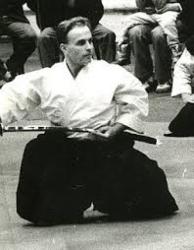
Roland Haberzetzer
 France
- Biography of Roland Habersetzer
- Early Years and Training
- Contributions to Karate
- Center for Budo Research
- Recognition and Achievements
Biography of Roland Habersetzer
Roland Habersetzer is a French karate master known for his talent as an artist and his expertise in various styles of karate and kung fu. He is also an expert in Tai Chi Chuan (Yang style) and teaches special units at the Strasbourg Police Academy while holding a modest position as a history and geography teacher.
Early Years and Training
Habersetzer began his martial arts journey in 1957 in the Judo section and discovered karate a year later, during its early development in France. Through intensive training under the guidance of the patriarch of European karate, Henri Plée, and his own dedicated work ethic, Habersetzer achieved his 1st Dan (black belt) in 1961. At that time, he became one of the first and youngest black belt holders in Europe.
Contributions to Karate
In 1962, Habersetzer opened a karate section at the Strasbourg University Club, where he served as the director and later as a technical advisor until 1990. This was the first dojo in eastern France and produced numerous karate masters, earning it the reputation of being a "forge of talent" for European karate. Thousands of karate practitioners passed through its doors.
Center for Budo Research
In 1974, at the peak of his sporting career and disillusioned with sports karate, Habersetzer left the French Karate Federation and established the "Centre de recherche Budo" (Center for Budo Research, abbreviated as C.R.B.). This international organization aimed to unite all Budo enthusiasts concerned about the future of Chinese and Japanese martial arts. Habersetzer authored over 60 books on Eastern martial arts between 1968 and 1998, including fundamental works on karate and kobudo, as well as lesser-known books such as "Iai-Do," "Tao Kung Fu," "Kata Ju-Do," "Ninjutsu," "Kung Fu Martial Arts" (Shaolin techniques), "Jiu-Jitsu," "Training in Martial Arts," "Kosiki-no-Kata," "Bu-Bi-Shi" (unknown pages of history, techniques, and kata of old Okinawan masters and schools), and many others. Some of his books were even pirated and published in the Soviet Union and Russia.
Recognition and Achievements
Habersetzer's teacher, with whom he maintains a warm relationship to this day, is Tsuneo Oshiro, a Japanese master holding a 10th Dan. Oshiro, in turn, learned the art of karate from Gogen Yamaguchi and Gima Makoto. While Yamaguchi is well-known among karate enthusiasts, Gima Makoto was one of the first and arguably the best student of Gichin Funakoshi, the Grand Master of Karate. In 1982, Oshiro presented Habersetzer with the 7th Dan, and in 1992, the 8th Dan. This is a rare honor for a non-Japanese master and a recognition of his dedication and achievements in the world of martial arts.
Another master whom Habersetzer considers his teacher and friend is Tadahiko Otsuka, the head of the Goju-Kenshi school, holding a 9th Dan.